
-
Kafilat Muhammad serves jollof rice to her customers in the Lagos market. Muhammad said she makes a living out of cooking and selling food during parties. “Nobody appreciates us food sellers. We have to spend so much money that we often don’t make any profit,” Muhammad said. (Photo by Atinuke Longe)

-
A Nigerian tomato seller offers tomatoes to customers. He was in conversation with one of customers as he tried to explain to them how hard it is selling vegetables in Nigeria. (Photo by Atinuke Longe)
Photo credit: Atinuke Longe
-
Abayomi Giwa stands in his fabric store, folding clothes and looking out onto the Lagos market. Giwa said inflation continues to affect undervalued fabric sellers like himself. “People never thinking about us. The people who sell and make the fabric, when talking about inflation,” Giwa said. (Photo by Atinuke Longe)
Photo credit: Atinuke Longe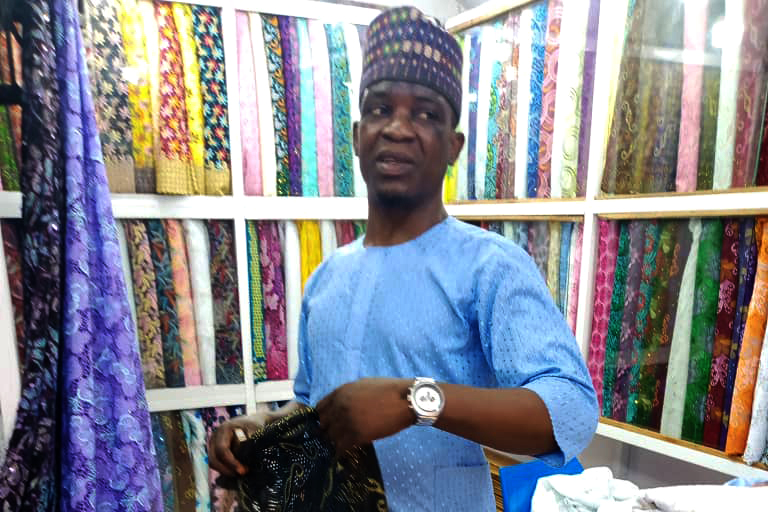
-
A Nigerian fish seller, Sade Abebi, grips a giant catfish with one hand and raises her cutlass with the other, ready to slice it for a customer. Abebi said it’s a routine she knows well, but inflation has made everything harder. Like many small business owners in Nigeria, Abebi is doing her best to stay afloat while prices continue rising.(Photo by Atinuke Longe)
Photo credit: Atinuke Longe
-
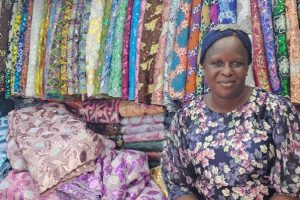
A lace seller whose name is Adebola Akunmilade holds up up a delicate green lace, its floral pattern catching the light as she tries to sell the lace to a hesitant buyer. With fabric prices rising and customers cutting back, Akunmilade said she is caught in a tough spot: trying to sell beauty in a time when fewer people can afford it.(Photo by Atinuke Longe)
Photo credit: Atinuke Longe
-
Abiodun Olayemi sits at her stall, surrounded by piles of fabric and waits for the next customer. For fabric sellers like her, Olayemi said that inflation isn’t just about higher costs, it means working twice as hard to make the same income. “Business is slow, and prices keep rising, yet every day I have to show up with a hopeful smile,” Olayemi said. (Photo by Atinuke Longe)
Photo credit: Atinuke Longe
-
A fabric seller whose name is Bolade Adesiji, poses in her shop behind her fabrics. As a worker in a small business rather than an owner, Adesiji brings a different perspective. “I have to go from job to job, and I’m getting paid less because buying lace is more expensive now,” Adesiji said. (Photo by Atinuke Longe)
Photo credit: Atinuke Longe
-
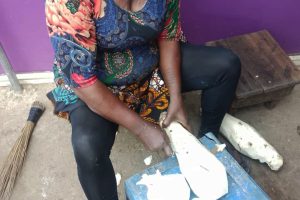
Ajoke Ayinde peels yams to cook pounded yams for her customer. Ayinde said having to do everything herself is one of the things that slows down her business. (Photo by Atinuke Longe)
Photo credit: Atinuke Longe



Editor’s note: The interview with Kafilat Muhammed was conducted via phone and translated from Yoruba by reporter Dara Alitoro.
In Nigeria, inflation is more than just an economic buzzword. It’s a force that shapes everyday life, especially for small business owners fighting to stay afloat. According to VerivAfrica, Nigeria has a long history of battling inflation, with some of the most severe spikes occurring in the 1990s. In 1994, the inflation rate hit 57.03% and jumped to 72.83% the following year. These sharp increases were driven by excessive money supply, expansive government spending and the weakening of the national currency. To bring inflation under control, the government tightened monetary policies through the Central Bank of Nigeria and reduced spending.
While economists analyze percentages and policy shifts today, this issue at hand is leading to more poverty. In 2022, about 133 million Nigerians lived in multidimensional poverty, due to rising inflation. Oracle reporter Dara Alitoro, who immigrated to California from Nigeria in 2018, reached out to her former community to see how inflation impacted residents. For many small businesses in Nigeria, especially those in sectors such as entertainment, clothing and food, inflation raises the costs of raw materials and leads to less profit for sellers.
Entertainment: Producing Big Ideas on a Tight Budget
Olaleke Alao is a business owner and part of Goal Tile International — a foundation that runs multiple small-scale entertainment ventures across Nigeria. Their work includes everything from reality TV to educational programs and podcasts.
“We’re into entertainment and events, and what we do is provide solutions and come up with ideas that can actually sell,” Alao said. “We have ‘Stakers Championship’, a reality TV show; ‘Fueling Dreams’, an educational show; and ‘Beer Parlor Diaries’, a podcast about serious social issues.”
One of Alao’s missions is to expose the realities of the massive sports betting industry in Nigeria. However, he said bringing that vision to life has not been easy.
“As a small business owner, when you have a project, you want to raise money and make sure your budget aligns with your goals,” Alao said. “But let’s say you budget one million Naira and go to the bank for a loan; you end up paying it back with 30 to 40% interest. That alone can kill your dream.”
For many entrepreneurs, Alao said, these high interest rates are worsened by inflation. This means a lot of small businesses struggle to even begin.
“The hardest part about being a small business in Nigeria right now is just surviving,” Alao said. “Inflation messes with your original plans, and if you don’t have a good shock absorber, that’s the end.”
Even once projects are underway, finding consistent funding is a constant challenge.
“There are so many times we’ve had to pause and ask other people for help because we don’t want to take another loan because of how high interest rates are,” Alao said. “You start looking for money from places you didn’t plan, and it gets tricky because you need the help, but you don’t want to seem too dependent.”
Clothing: Selling Fabric in a Market That Won’t Listen
Abayomi Giwa, a fabric vendor with more than 2 decades of experience sells textiles to tailors. He’s seen firsthand how inflation affects every part of the supply chain, but he said vendors like him are often left out of the conversation.
“When people talk about inflation, they mention food, they mention business and sometimes even tailors, but not the vendors who actually make or sell the fabric,” Giwa said. “We make the fabric or buy it from others, and then sell it to tailors who don’t always understand how expensive things have become. So when our prices go up, they get angry.”
Giwa said navigating inflation takes flexibility and humility in a business built on negotiation and trust.
“You can’t be proud in this business,” Giwa said. “Sometimes I have to beg customers to buy our fabrics, and sometimes they buy, and sometimes they don’t. But at the end of the day, I need the money, so every day, I do what I can to survive.”
Giwa expressed deep frustration with the Nigerian government, saying it has abandoned its people, especially under the current president, Bola Ahmed Tinubu. According to recent data from Vanguard NGR, inflation in Nigeria has soared to 34.9%, with food inflation alone surpassing 40% in 2020.
“We, as small business owners, are struggling, and the way things are going, it feels like the government is only making inflation worse,” Giwa said. “Then they act surprised when people are angry, but if the economy is this bad, how are we supposed to survive?”
Giwa explained that after many years in the fabric business, he has watched what was once a stable trade turn into a daily uphill battle.
“My biggest challenge now is that customers simply no longer have the purchasing power,” Giwa said.
“The purchasing power of the people has reduced drastically,” Giwa said. “We have to keep begging customers to stay. But we, too, are in the system. We’re struggling like them. Still, it hasn’t changed how I feel about my business; I have no choice; I have to survive; I have to adapt.”
Giwa also pointed out how online shopping has taken over, leaving physical stores like his at a disadvantage.
“The biggest issue right now is the lack of capital. There’s no money,” Giwa said. “Imagine taking out a loan and being told to pay it back in six months with 30 to 40% interest per annum. That’s one of the major challenges. We, as small business owners, are not helped enough by the government.”
Food: The Struggles of Food Sellers in Nigeria
Kafilat Muhammad is a native Yoruba speaker and the owner of Ekafland Food Caterings. She sells classic Nigerian dishes like jollof rice, fried rice, amala and eba. Muhammad said cooking has always been part of her life; she started helping her mom sell food when she was just a little girl.
“We used to carry big buckets of food on our heads and walk from street to street, calling out to people to come and buy,” Muhammad said.
Now that she runs her own catering business, Muhammad said things aren’t as easy as they used to be, especially with how much everything costs.
“People sometimes think we’re overcharging, but they don’t see how expensive ingredients have gotten,” Muhammad said. “Before, we could buy what we needed and still make a profit. Now, everything, like rice, oil, gas and even water has gone up. Plus, there’s rent, staff salaries and so much more. It all adds up.”
She said many of the ingredients she now buys are lower in quality than before, despite rising prices.
“Even the peppers, tomatoes and seasoning cubes we use every day are now not just more expensive but also not as good,” Muhammad said. “You pay more, but the food doesn’t even taste the same unless you use more. So that’s more cost again.”
Muhammad described that the pressure to balance rising costs with customer satisfaction has led her to increase the prices of her meals— something that hasn’t been well received.
“When we raised the prices, some customers got upset. They’d shout, argue and even return the food after eating part of it,” Muhammad said. “They don’t understand that we’re not trying to cheat them. We’re just trying to survive.”
According to New Ventures Advisors LLC, many small food business owners across Nigeria have to adjust prices instead of shutting down entirely. Yet even after raising prices, the profit margins are often so thin that they barely cover daily expenses.
“Sometimes, after paying for everything like gas, water, shop rent, ingredients and salaries, what’s left is nothing. And if someone wastes food or refuses to pay, we take a loss,” Muhammad said. “There are days we don’t make any money at all.”
Muhammad said beyond the financial toll, there’s physical and emotional strain.
“I wake up before the sun to start making food and don’t stop until late at night,” she said. “It’s hard work. You sweat all day, you push through tiredness, and in the end, it can feel like it’s for nothing.”
Muhammad described the people who are the most affected by inflation and what has made it harder for them.
“I think people like me who sell food are the ones affected the most by inflation,” Muhammad said. “We’re at the bottom of the supply chain, and I, for example, have to pay for transportation along with all the other stress that I do.”
Proposals
Despite facing daily challenges, all three small business owners agreed that the government must take urgent, concrete steps to ease inflation and support small businesses. Each spoke passionately about the changes they believe are most critical.
Muhammad stressed the need for stronger, more open communication between the government and its people. Alao called for real, reliable support systems that allow small businesses to thrive. Meanwhile, Giwa urged immediate action — no more empty promises or delays.
“I think the government should talk more with its people so they truly understand what we need,” Muhammad said. “They need to lower prices on electricity and basic food supplies. That’s the only way we can build a stronger, more stable economy for Nigeria.”
In the video below, reporter Dara Alitoro explains how inflation has risen from 2021-2024 overall and in sectors like food and clothing.