


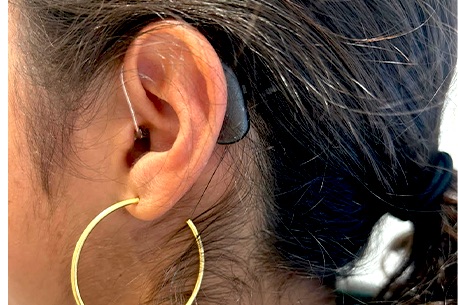
People often confuse deafness with inability, assuming that people with hearing loss don’t have the same or as strong of skills as hearing people. In reality, that is not always true. In many cases, they just don’t have to have the opportunity to build those skill.
According to the World Health Organization, around 95.1 million children aged 5 to 19 years old live with hearing loss worldwide.
No Limits for Deaf Children and Families is a non-profit organization that offers a wide range of free services — including speech therapy, literacy tutoring and theater arts — to underserved deaf and hard-of-hearing people aged 0 to 21 years old and their families. Founded by Michelle Christie, the organization aims to enhance communication skills, self-esteem and confidence among its beneficiaries. Additionally, they provide free classes and support to assist families navigating educational and medical systems.
Christie said that, while volunteering at a deaf program, she met a little boy named John who had a limited vocabulary, knowing only around 50 words at 7 years old. According to the American Psychological Association, a child from 6 to 10 years old already knows 5,000 to 20,000 words. Christie said she was concerned that because of this, people wouldn’t give John the same opportunities and chances even though he was perfectly capable. John inspired Christie to start No Limits so she can give deaf children those opportunities.
Christie said it is important to let deaf children and their families know that they are not alone. There are so many people who share a similar story and have kids just like them that have a hearing loss and even the same hearing device, she said.
“It’s very rare to see that connection, like what you have is so powerful, and it makes you not feel like you’re the only one. And so I feel like my job is just to keep connecting and providing experiences for kids to be with others like them,” Christie said. “My dream eventually would be to have a deaf CEO take my place and just have the whole company run by people with hearing loss because they’re so capable, and they definitely can do it.”
Christie said she started No Limits for families who can’t afford to buy the proper technology for their deaf child. This provides a safe space for their child to improve their speaking abilities and helps and supports the family learn how to navigate the world alongside their deaf or hard-of-hearing child.
“All the kids were practicing speaking over and over again, and they were with other kids like themselves so they didn’t feel alone,” Christie said. “Everyone was working on the same thing, and what’s amazing about it is those same kids are all best buds to this day. So connecting people with language is so important for you to feel good about who you are, let alone be able to succeed in school and life.”
According to the National Institute on Deafness and Other Communication Disorders, a cochlear implant is a small electronic device that helps people with severe hearing loss perceive sound. Instead of amplifying sound like a hearing aid, it bypasses damaged parts of the ear and sends signals directly to the hearing nerve. An external part picks up sound, and an internal implanted part converts it into electrical signals that the brain interprets as sound.
Jacob Aquino is an alumnus of the program who is deaf. He started at No Limits at the age of 3 and now works there on the weekends. Aquino did not start with cochlear implants but was able to get them as he got older, which he said helped a lot with his hearing, speech and life skills.
“No Limits was really the safe place for me and others like me. It really helped me feel comfortable being deaf and gave me confidence,” Aquino said. “They taught me about parts of the ear and especially in English, like reading and writing skills. So now, I’m doing pretty great with that, thanks to them.”
Experiencing sound through a cochlear implant differs from typical hearing and requires time for individuals to learn or relearn some tones of voice or unfamiliar noises. Nevertheless, it can enable individuals to identify warning signals, comprehend various sounds in their surroundings and understand spoken language both in person and over the phone.
“They didn’t feel different from others, even kids with hearing aids, because they are not the only ones with a cochlear implant,” Christie said. “They are able to connect with other kids that have the same device as them, because with each device comes a different experience.”

Aquino has a sister, Amanda, who became involved with him at No Limits and attended his therapy appointments and sessions. Amanda Aquino said it was a joy seeing Jacob evolve and grow over the years.
“It was really cool seeing how they went from not speaking clearly to being more clear with their speech,” Amanda Aquino said, “and it was very nice to see the kids improve.”
Freshman Liana Awai recently got hearing aids after discovering she had hearing loss over the most recent Thanksgiving break. Awai got COVID-19 during the break and said she lost part of her hearing because of it. Upon returning to school, she noticed that when she listened to her teachers and friends, she struggled to make out the words they were saying.
“I had a hard time understanding the content and class, causing me to fall behind,” Awai said. “It really makes everyone feel better about themselves when they can hear, so get hearing aids if you can, and don’t let other people judge you because of it.”
Christie said, when she was younger, she didn’t like public speaking, but theater allowed her to play someone else and share their voice instead of her own, which gave her a lot of power and confidence. This led to Christie making No Limits, a theater program that works on multiple necessary skills for children with hearing loss, while making a play for the families to see. She said her idea was to break the stereotypes of what kids with hearing loss can and cannot do.
“The reason No Limits focuses on underserved children is because I want the child to have a choice. There are no limitations. Our kids are awesome,” Christie said. “They’re kids who have hearing loss, but it doesn’t define them. They need more resources at times in their lives, and that’s our job to provide.”
Awai said she did not get hearing aids right away because she knew that it would be a significant change to her life. But she said she realized they would help her in class, with social interaction and even at home.
“At first I was hesitant. I didn’t want to get hearing aids because I knew it would be a big adjustment,” Awai said. “My first reaction was, ‘Wow, I can finally hear,’ and my mom was so happy for me. I felt proud that I could finally hear and understand and listen.”
Jacob Aquino said it is important for hearing people to know that, for most hard-of-hearing and deaf people, as long as you speak clearly and talk directly face-to-face, communication should be easy and smooth. If they don’t have their hearing device on, they will tell you otherwise.
He said if a deaf or hard-of-hearing person asks you to make a simple adjustment to better hear you, please do so in order to avoid any further complications. He said it is important to understand that speaking with a person with hearing loss may require some extra attention if needed, but know that you can still have a normal, flowing conversation with them, just as you would with anyone else.
Awai said that one of the hardest parts about hearing loss is not being able to comprehend what people are saying in a group. Even if people understand you cannot hear, people with hearing loss can still feel excluded from the group.
“There are times when my friends are talking about something and they’re like, ‘Wait, I don’t understand because I can’t hear them,'” Awai said. “I miss social cues sometimes when I’m with my friends and they are really loud; I don’t always understand stuff, so I just sit there and observe because I don’t really understand what’s going on.”
In the audio clip below, Michelle Christie talks about a time where one of the kids had a proud moment. The theater program is designed to help young kids feel confident to speak out and show who they are, and after many weeks of trying, one of the kids did.



Isabel Kromwyk • May 27, 2026 at 2:55 pm
Yaya! I love your article so much Avery! It turned out so well!