



Five years ago, Archer started participating in Poetry Out Loud. Classes were online in the midst of the pandemic, and English teacher Kathleen Keelty — who had been trying to introduce the program into Archer since 2018 — felt students needed a way to express themselves while separated.
“When I first came to Archer in 2018, I wanted to introduce the program then, but there were so many other competing performing arts opportunities that it just wasn’t yet the right time,” Keelty said. “When we went into lockdown … [the administration] said, ‘Yep, that would be great. We need another opportunity for kids to be doing stuff that is meaningful and that reaches outside of Archer as well.’”
Poetry Out Loud is a national competition in which high school students recite poems from the Poetry Out Loud website, which was jointly managed between the National Endowment of the Arts and Poetry Foundation, Keelty said. Students compete in classrooms, followed by schoolwide, countywide, statewide and national competitions.
In 2022, Archer was in its second year of participating in Poetry Out Loud when then-junior Mia Ronn won the national competition. In 2023, then-junior Anaiya Asomugha won the Los Angeles regional competition, and in 2025, Selah Johnson (’26) won the California state competition.
On Saturday, Oct. 11, Johnson was looking through Poetry Out Loud’s website to figure out which poems she might perform, when she realized something had changed about the site. Not only had the website’s color scheme shifted from its signature purple to a blue, but Johnson could not find any of the poets she was looking for — all of whom were Black. Johnson frantically emailed Keelty.
Upon further inspection, the two realized that there were still Black poets featured on the website — just not any poet, of any race, from the past hundred years.
“As the nation prepares to commemorate its 250th anniversary, the federal government is emphasizing programming in 2026 that honors American history and culture,” the Poetry Out Loud website states. “Accordingly, the poems selected for the 2025-2026 Poetry Out Loud competition highlight American poets as well as poems that embody the nation’s indomitable spirit, creativity, innovation and the nation’s rich cultural and historical heritage.”
Johnson said if the goal of the new site is to highlight the American experience, she does not understand why the site omitted certain canonical American poems while keeping others.
“There were so many gems on this site that were poems about resistance and social change and different social commentaries — and to think that they’re not there, to think that poems like ‘1st VOTE,’ about women gaining the right to vote, does not qualify as an American poem, is extremely confusing,” Johnson said. “I don’t understand the selections that they made, and I think that that’s where a lot of the frustration comes from … how could you not include this poem? How could you not include that? How could you include William Wordsworth? Why is this British romantic poet in the ‘celebrating American poetry’ [website]? It just doesn’t make a lot of sense.”
The Poetry Out Loud website also states that the changes were made because Poetry Foundation, which provided licensing for all poems on the website, announced it would cease their partnership for the 2025-26 school year.
“With this substantive change and the length of time it takes to obtain poem permissions, this year’s anthology includes poems in the public domain that celebrate the rich tapestry of American history and culture,” the website states.
Other notable works of American poetry that used to be on the site were glaringly absent, such as the work of Emily Dickinson and Langston Hughes’ famous “I, Too” and “The Negro Speaks of Rivers,” both of which are in the public domain. The Oracle reached out to Poetry Foundation and the National Endowment of the Arts via email. Both declined to comment on why their partnership has ended and each referred The Oracle to the other site. Regardless of the reasoning behind the new changes, Johnson said their impact is immense.
“A lot of the poems being more than 100 years old by Black poets limits a person’s understanding of what the Black experience is, because if your understanding of Black life and Black culture stops at the year 1925, there’s a lot you’re missing from that story,” Johnson said. “There’s a lot of social change you’re missing — historical events, key figures that were not around then … It just erases the true idea of what it means to be a Black American, and shrinks it down to this single image of what it meant to be a Black American 100 years ago, and I just — that’s something that I really cannot stand for.”
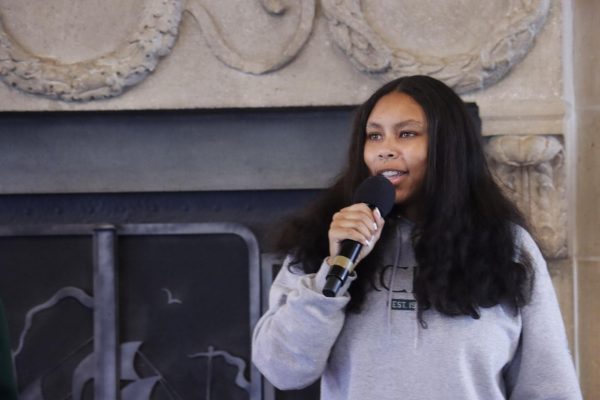
Poetry Out Loud 2025 national winner Isavel Mendoza agreed the change in partnership is not a sufficient reason to have such a lack of diversity on the site; many public domain poems discussing racism and other divisive issues could have been included on the site, but were not, such as Hughes’. The majority of remaining poems are by white poets.
“That’s not a real response,” Mendoza said. “You are aware of what you’re doing, and so you’re saying it a different way, but that’s just not the answer.”
Johnson and Keelty decided they could not continue participating in the new version of Poetry Out Loud; it no longer aligned with their and Archer’s values. They decided to pull Archer from the competition and create their own, titled by History teacher Bethany Neubauer, “Poetry Allowed.”
“We aren’t sure exactly how permanent [Poetry Allowed will] be, but for at least this year, we want to continue sharing the power of poetry with students, just through a different form,” Johnson said. “One where students will have the ability to pick poems that are diverse and contemporary and talk about political issues they’re interested in.”
Los Angeles County Office of Education agreed that this new version of Poetry Out Loud was not one they wanted to participate in. In consultation with the Los Angeles County Department of Arts and Culture, they made the formal decision to pull Los Angeles county from the competition, LACOEA Arts & STEAM Coordinator Jeannine Flores shared via email Thursday, Nov. 6.
“After careful review of recent changes to the national Poetry Out Loud anthology and competition materials, LACOE determined that the current direction of the program no longer aligns with our organizational values of equity, inclusion and representation,” Flores wrote. “We believe it is vital that all students see themselves reflected in the literature and art they study and perform.”
The state of California as a whole has yet to withdraw from the competition, in part because many schools’ art funding is allocated specifically for Poetry Out Loud, Keelty said. If those schools withdraw from the competition, they will lose the funding that comes with participating.
“We’re in the process of creating a program that we can use specifically for Archer,” Keelty said, “and we’re also considering inviting other schools in Los Angeles to join us in … a larger contest.”
Junior Adella Travers has competed in the schoolwide Poetry Out Loud competition in past years and is currently coding a website for the Poetry Allowed anthology. She said she was devastated when she learned about the changes to Poetry Out Loud, but she was glad to be able to make the website for the new competition. Students are able to submit poems they want to be featured through a Google form Keelty created, which is linked on the site. Travers then adds submitted poems to the website.
“Because this is an entirely new program … we don’t have a set of poems preselected,” Travers said. “That is a challenge of this program, but it’s also one of the coolest parts, because it means that we as the students get to be the ones who choose the poems based on what we like and what we think is cool and what speaks to us … It’s important for us to have our own site because Poetry Out Loud … doesn’t [currently] have a selection of poems that is representative of diverse people and voices, and we want our poetry recitation competition to feature poems that all students can identify with and relate to and see themselves in.”
On the other hand, Mendoza recommended continuing involvement in the national competition — not to abandon it, but to resist it from within.
“I think there’s value in trying to find reason in why they’re doing this and honestly fighting it and attacking it head-on with questions,” Mendoza said. “People overestimate what a protest has to be. But literally, if someone just asked … ‘Why did you take that [poem] off [the site]?’ First, it catches people off guard. And second, it makes people actually think. And then when you show that you care about something like that, political, anything being messed with or touched — that is innately resistant.”
Johnson, Mendoza and Keelty all agreed that the experience of Poetry Out Loud is incredibly important. Keelty said it lets students connect to people with vastly different life experiences from their own and understand how all humans are connected. Mendoza added that learning poetry extends beyond the competition.
“Poetry is everything. Everything in the world revolves around rhythm, tempo, stanzas, rhyme schemes,” Mendoza said. “If you really, really look at … how the world works, and even the repetition — poetry is just endless. And so when you think about slam poems or music … you find this solace that people are connecting with because they find themselves represented, or they find an emotion represented, and that’s what poetry does.”
Mendoza said no matter what happens, society must continue getting angry when they witness injustice.
“Don’t stop caring about this because it’s only the people that care that keep things,” Mendoza said, “because some people are just so indifferent, and indifference is not an option. You can’t not care.”


Carrie Lloyd (parent) • Dec 16, 2025 at 7:19 am
I couldn’t be more proud to be a member of the Archer community. Bravo, Selah, and Prof. Keelty!!!! Poetry Allowed is such a brilliant response to this injustice. Wishing you all the best.