


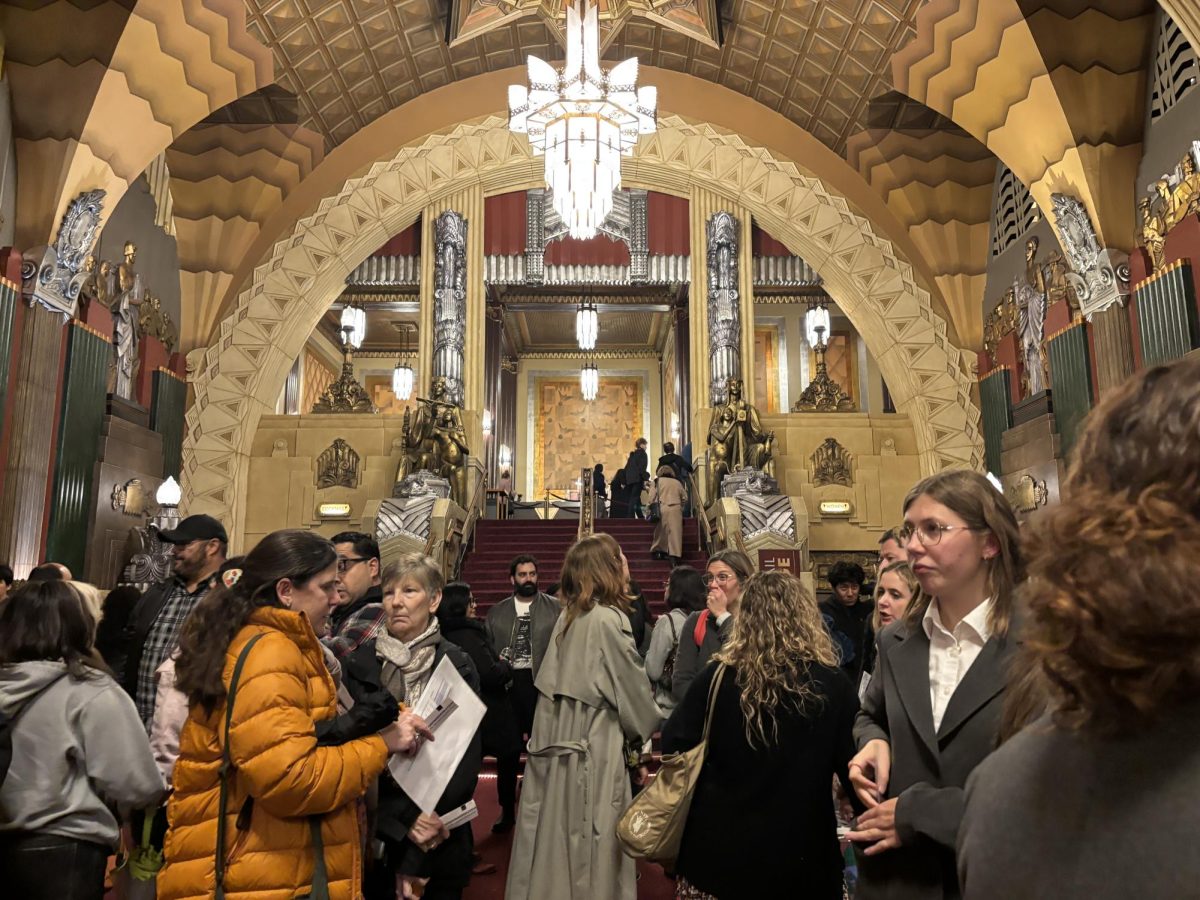
On a brisk evening in Los Angeles, Archer upper schoolers donned dry charcoal blazers, unaware of the coming storm. Soon, the sky turned, and a downpour of rain flooded the streets: the perfect weather to head into a theater and learn about the Suffrage Movement.
In celebration of Archer’s 30th anniversary, Archer offered all upper schoolers the opportunity to attend a field trip to see the new musical “Suffs” after school Thursday, Nov. 20, at the Pantages Theatre. Buses were organized to depart from Archer at 5:30 p.m. and pickup was arranged at 11p.m. at a lot near Archer. Teachers volunteered to be chaperones for the trip, and each teacher was assigned a small group of students to sit with during the show.
From the minute I read the email presenting this opportunity, I knew I wanted to attend. As someone who grew up in New York City, musical theater has always been present in my life, and the chance to see “Suffs” felt like a reconnection with my roots.
I find it very interesting when theater is used to portray and illustrate history. Several productions, including “Julius Caesar,” “Ragtime,” “Annie Get Your Gun“ and the modern sensation, “Hamilton,” are all well-known examples of how historical events and figures can be portrayed through performing art.
“Suffs,” written by Shaina Taub, covers the progression and impact of key figures in the women’s Suffrage Movement. The show features two groups of people who desire suffrage for women but disagree on the path to take to get there.
Something that stuck out to me was how the cast was entirely female, with female actors even playing male roles like former president, Woodrow Wilson. I loved how the show featured and employed many female actors. This decision felt very true to “Suffs” message of female empowerment.
From a parade to the president’s office, the immersive set of “Suffs” was extremely effective in setting each individual locations. They picked key details to mark each individual room, so the audience could understand the location of each scene. For instance, in one room, there was a photograph of Inez Milholland riding a horse in a woman’s suffrage parade that hung on the wall; this easily clarified to me that the intended location was the National Woman’s Party headquarters. Milholland collapsed during a speech to promote women’s suffrage in Los Angeles and was later pronounced dead, and the photograph was hung in her honor according to the musical.
Out of all of the sets, my favorite was definitely the one outside of the White House, where a metal gate was constructed, because the whole scene was very realistic. This was also supported by the actors, who moved in slow motion, chanted, pounded their fists and yelled to represent a crowd of feminists protesting.
I also thought the costume design was — for the most part — clear. At times, it was difficult to distinguish between characters because they were all wearing similar petticoats and gowns. However, when opposing groups interacted, it was very clear who was on what side thanks to the unique color schemes of each party.
The show began with the cute and catchy song, “Let Mother Vote,” that was repeated later on. This song was one of the ones that stuck with me because I thought it was a very strong mark to the start of the show and suffragist journey. It had a sweet and pleading tone, which highlighted the older suffragettes deferential, strategic approach to fight for suffrage.
Another one of my favorite songs was “If We Were Married,” which featured a conversation between Assistant Secretary of State Dudley Malone and suffragist Doris Stevens. The man is describing his idea of an idealistic life, while the woman counters with the reality of marriage for women. At the time period this musical is set from 1913 to the early 1920s, marriage for women entailed becoming their husband’s property and losing any financial responsibility.
While some songs were catchy, I found several to be quite repetitive. Many songs followed similar rhythms, which sometimes felt very mundane to watch. Because the songs were all very similar, the show felt very slow, almost like you were stuck in place.
I wish they had included more events in their timeline because at times scenes felt overdramatic in an effort to make the story more elaborate. I also would have liked if the show gave more airtime to other suffragist leaders and groups because the main characters, which included Alice Paul, Lucy Burns and Inez Milholland, felt boring to watch at times due to a lack of depth in character. The main character, Alice Paul, fell to the background against her more interesting counterparts.
While I appreciated the varying personalities of the characters, I think it would’ve been nice to give certain characters more development beyond their initial persona.
Another aspect I appreciated about the musical was how it touched upon Black women’s suffrage, which was often overlooked by the majority of the Suffrage Movement. The show referenced specific Black historical figures, including Ida B. Wells, who was an investigative journalist, educator and one of the founding members of the Civil Rights Movement.
The musical effectively explored how suffrage for white women often came at the expense of Black women. The musical displayed these inequalities throughout the show by including an argument between Alice Paul and Ida B. Wells about how Black women were forced to walk in the back of the woman’s suffrage parade and not welcomed equally.
Overall, I enjoyed this rainy-day excursion to the Pantages, and I thought it was a very unique way to learn more about the Suffrage Movement. I think it is essential to learn about history through a variety of ways, whether it is in a classroom or theater. I loved that I got to experience the performance alongside an audience from an all-girls institution.
-
Story
-
Acting
-
Technical Quality
-
Enjoyment
-
Impact
Summary
Suffs is an eduacational and fun musical production, which follows members of the suffregete movement. The show consists of fairly simple sets and costumes, but they are very effective at telling the story. Some of the songs were at times repetative, and the plot could have been more engaging and had more twists and turns. Overall the show was informative, and provided a diffrent medium to learn about the suffregette movement.


