According to the Pew Research Center, American society is becoming increasingly politically and socially polarized. Whether it is topics like the Trump administration, reproductive rights, immigration reform or social issues, disputes over policy are drastically divided on different sides of the political spectrum.
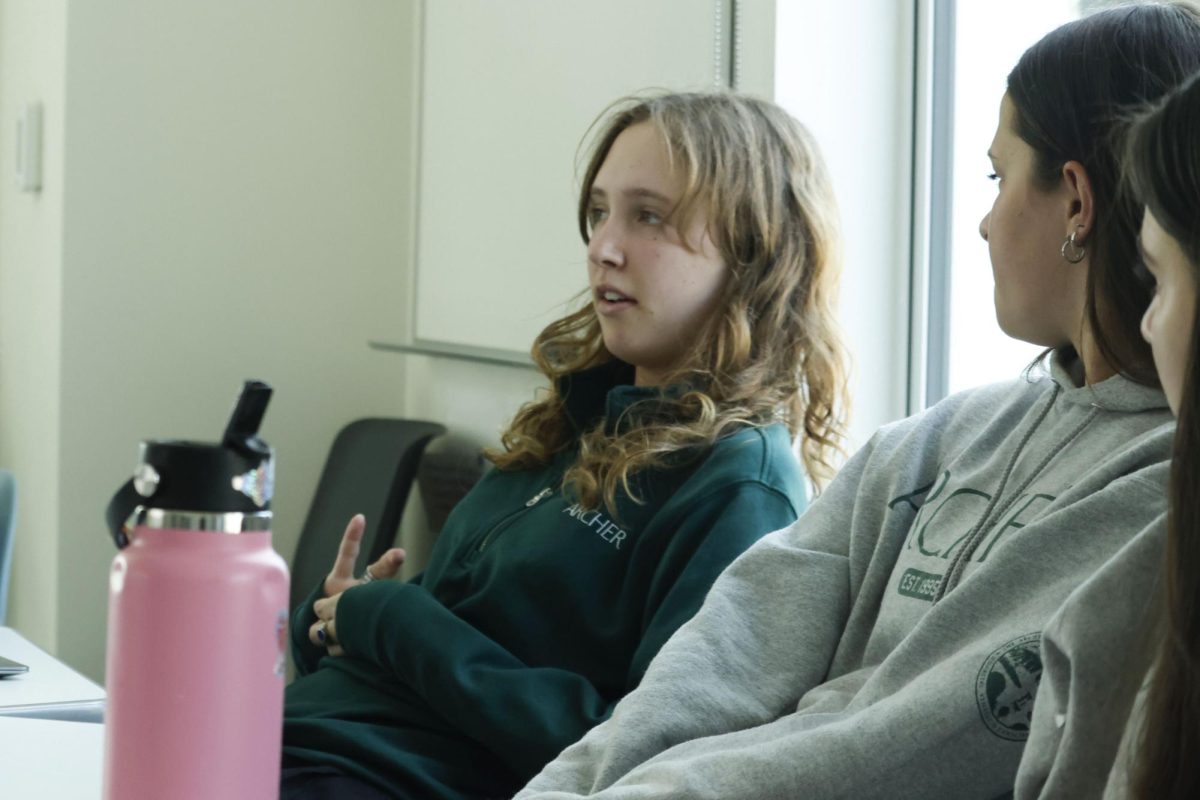
The Artemis Center hosted its monthly event, ArtemisEngage, Monday, Jan. 26, taking place during upper school FLX block. While ArtemisEngage discussions are usually optional, all upper school students were required to attend this one. Students were split into groups led by Artemis Center board members. The purpose was to encourage students to be more open to opposing viewpoints and changing their personal beliefs.
This ArtemisEngage featured an episode from film teacher Brooke Sebold‘s series, “I Changed My Mind.” The episode follows Adrianne Black, who was born and raised as a prominent member of the American white nationalist movement in West Palm Beach, Florida. Black unlearned the ideologies she was taught as a child when she attended New College of Florida. Black later came out as transgender in 2024.
“It’s the concept of intellectual humility,” Sebold said in an interview, “which is the person’s capacity to change their mind given new information, and how to cultivate that within our own lives.”
History teacher and Artemis Center Director Beth Gold said healthy debate is important for students to find common ground on certain issues. Gold said teaching students about tools like constructive discourse can help them find shared objectives and ideas in future interactions.
“We are living in a world that everyone is disappointed in terms of how polarized people are and unable to find common ground or even, now, engage with each other,” Gold said. “A democracy depends on people who are willing to engage, willing to participate, willing to discuss and debate.”
Attendee Sophie Herbert (’28) said her group reflected on if they would be willing to change their minds and have a productive conversation with someone of different views. Herbert said while it can feel challenging to engage in discussions with those who have differing opinions, those conversations are necessary to progress as a society.
“It is really, really important,” Herbert said. “Change cannot happen unless we have discussions and we are able to speak with each other equitably and not argue all the time.”
Sebold said participating in civil debate is crucial, especially during a time when society is deeply divided. They said being open to new stances does not mean entirely changing one’s mind about it.
“It means being open to the new information and letting it settle, and understanding whether or not there might be some flaws in your own thinking,” Sebold said, “or whether or not this actually just affirms what you already know to be true, and that your beliefs actually are aligning with your values on whatever the issue might be.”
To have a successful discussion, Gold said students should try to understand how views are driven by values. She said understanding someone’s identity, traits and experiences will provide students with coherence on why people have certain opinions.
“There isn’t necessarily going to be a change of opinion on anyone,” Gold said, “but I think it bringing people together to discuss is going to be more fruitful than just people going into their corners and not engaging with each other.”
Correction Statement (Feb. 3, 2026, 10:22 a.m.): A previous version of this article used the phrase “relearned the ideologies Black was taught” while at New College of Florida. The article has been edited to replace “relearned” with “unlearned” to clarify meaning.