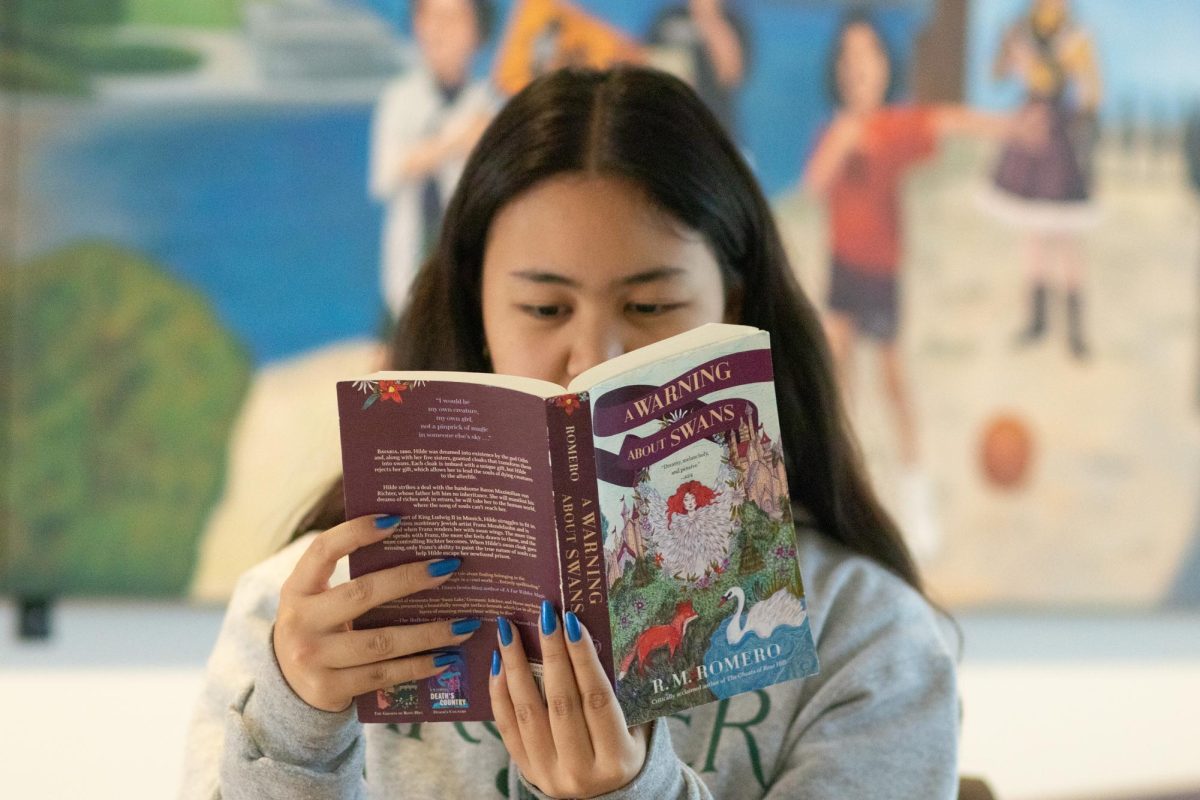
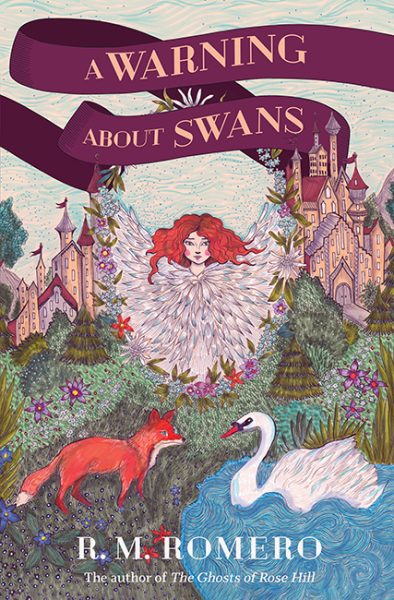
Desperate deals driven by a hunger for more, bitter emotions cloaked in stiff etiquette and dreamy lines of poetry that evoke a enchanting realm. “A Warning About Swans” by R.M. Romero is a ravishing fantasy novel that offers refreshing angles on classic fairy tales as well as complex, fleshed-out characters. Published in 2023, the book is a page-turner that combines antiquated, contemporary and magical elements to detail one girl’s journey towards independence and self-discovery.
“A Warning About Swans” takes place in Germany during the 1880s. The story follows Hilde, a strong-willed maiden who lives in the Bavarian woods with her five sisters. At the age of 9, they each receive a swan cloak from the All-Father Odin that grants them a unique power and role in the forest. While her sisters receive desirable attributes like super-speed or a mellifluous voice, Odin tasks Hilde with carrying on his duty of guiding the souls of dying creatures to the afterlife.
As time goes on, Hilde grows weary and resentful of her power and its burden. She runs away at the age of 16 after striking a bargain with Baron Maximilian von Richter, a scheming nobleman with dark secrets hidden behind a veneer of benevolence.
After taking her to the human world, Richter shelters Hilde in his castle and uses her magic to bring his dreams of riches and power to fruition. In her naïveté, Hilde trusts Richter completely at first, before realizing the true cost of their pact: She may have traded her previous prison for another psychologically abusive one.
The novel is written entirely in verse — an interesting choice I rarely see authors make. Instead of neatly lined up paragraphs of prose, Romero weaves together beautifully articulated stanzas, punctuated by line breaks and parentheticals that offer sharp and often foreshadowing commentary.
Even though verse books might seem unappealing to readers used to the pacing and directness of prose, Romero masterfully crafts a nimble, cohesive story that feels more like an epic tale than a strung-together poetry collection.
Unlike other fantasy books, such as Sharon Messenger’s “Keeper of the Lost Cities” or Leigh Bardugo’s “Grishaverse” franchise, which have an abrupt twist and shift of perspective at the end of a chapter, “A Warning About Swans” flows smoothly from one section to the next, minimizing chapter breaks. Coupled with the lilting rhythms of Romero’s writing, this literary choice evokes the feeling of a classic folk tale passed down through oral tradition, which makes the book even harder to put down.
In a 2024 interview with Geeks OUT, Romero described “A Warning About Swans” as a combination of “The Last Unicorn,” “Swan Lake” and Brothers Grimm fairy tales. Readers can clearly see these influences in the intricate world-building and ethereal diction. Romero also said she was inspired to write this story after visiting King Ludwig II of Bavaria’s iconic castle Neuschwanstein. The castle was commissioned in the 1800s as a tribute to composer Richard Wagner and the legend of the swan knight that inspired his famous opera “Lohengrin.”
In a clear nod to these historical events, Richter takes Hilde (and his newfound wealth) to the court of King Ludwig, a supposedly deluded monarch who is in the process of building a “fairy tale castle.”
As she becomes acquainted with court life, Hilde befriends Franz Mendelsohn, a nonbinary Jewish artist with the uncanny ability to craft paintings depicting the truth. Over time, Franz and Hilde earn each other’s trust and bond over not fitting in with the rest of the nobility; Hilde’s unfamiliarity with court etiquette and Franz’s blunt honesty land them in awkward situations.
Unlike Richter, who views Hilde as a dispensable tool, Franz loves her for who she truly is. Their connection is poignantly demonstrated when Franz paints Hilde’s portrait, rendering her with swan wings — an image of her true self.
In the novel, Franz’s queerness is presented as a matter-of-fact aspect of their identity. By including a nonbinary character as a love interest, Romero not only updates the heteronormative romances in traditional folklore but also illuminates the inherent queerness of fairy tales in a nuanced manner.
Whether it’s Mulan passing as a male soldier or the big bad wolf in granny drag, gender (and species) fluidity is a common throughline in folktales. In a world where magic is prevalent and fantastical creatures roam the earth, what is so unusual about one genderqueer human falling in love with a swan-maiden?
Overall, “A Warning About Swans” is a thoroughly delightful read. It is not only entertaining — it is full of complex interpretations of history and folklore that offer a contemporary lens on fairy-tale fantasy. Romero’s unique writing style perfectly captures the whimsies and thorns of Hilde’s exploration of what it means to be authentically herself — even if that means rejecting others’ expectations of who she is supposed to be.
Readers of all ages who have struggled to find their place in the world are sure to resonate with the bittersweet reckonings of Hilde’s attempts to craft her own version of happily ever after.
-
Story
-
Writing
-
Characters
-
Enjoyment
-
Impact
Summary
“A Warning About Swans” is R.M. Romero’s third book. It is an ethereal, enchanting novel that uses elements of poetry, history and fairy tales to create an enthralling world, starring a swan maiden named Hilde who surrenders her power to guide the dying souls of animals to their next life for the taste of freedom. However, Hilde soon realizes that a cage has been built around her by someone she thought she could trust. It is an entrancing fantasy that is sure to amaze all readers.