Lunar New Year, which originated in China, is the most popular holiday celebrated in China and Chinese communities. Today, it is honored around the world. The holiday began Tuesday, Feb. 17, and the celebration lasted 15 days in relation to the cycle of the moon, honoring the arrival of spring and start of a new year on the lunisolar calendar.
Each year, the holiday honors an animal based on one of the 12 Chinese zodiacs. This year is the year of the horse, which is associated with optimism, forward momentum, freedom and action. Some common Lunar New Year traditions include cleaning the house, gifting red envelopes of money as a wish of good fortune, staying up late on Lunar New Year’s Eve and lighting firecrackers.
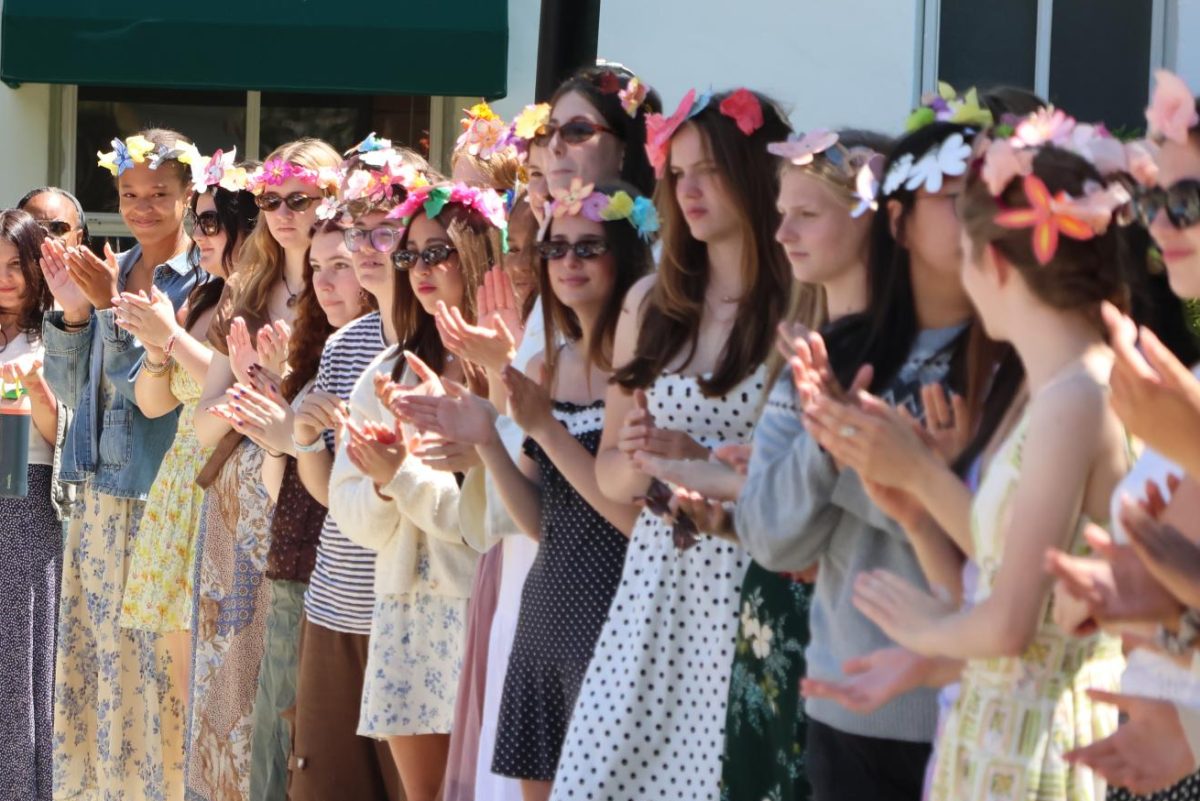
The Archer community gathered in the main courtyard to commemorate the Lunar New Year Friday, Feb. 20. Booths with games, food and activities lined the courtyard’s walkways as music echoed through campus. Students who are taking Chinese language classes hosted the celebration, along with members of the Asian Pacific Student Union. Archer’s festival featured activities like singing, a fashion show, the dragon dance, the umbrella dance and Chinese acrobatics.
Chinese teacher Pei-Ying Gosselin typically organizes Archer’s Lunar New Year festival. However, she said this year there was more student input on the performances and the designs of each booth. She offered some ideas, and each class then decided which performances they were interested in doing, she said.
“Usually, each class has one performance and one booth that they are presenting … One or two weeks before the festival, we start practicing or start preparing for the festival,” Gosselin said. “[We] want to teach the Archer community about Chinese culture, so each performance or booth has some cultural aspects behind it … If you go to different booths, the students will explain what cultural perspectives are in each booth or performance. They will also talk about their background.”
Gosselin’s students created hairpins and fans by working in Archer’s IdeaLab with a 3D printer. In class, Gosselin taught students about the cultural significance of these items. A ceremony called Ji Li is held when girls turn 15, which allows them to wear the hairpin, signifying their transition into adulthood. Her students made white, pink and green pins to mimic jade and wore them when the fan dance was performed.
“I like to design the curriculum for the students to integrate different disciplines because I feel like language learning should — they should be able to use their skills in different aspects to learn about the culture,” Gosselin said. “It is very beneficial for our students, because my goal is not just for them to sit in the classroom to learn the Chinese language, but to use their passion, their skills and their potential to integrate culture in the process of learning this language.”
Camille Chi (’28) said she celebrates the Lunar New Year by inviting family over and with traditions such as gifting red envelopes. She said she led morning exercise during the festival along with her classmates in Chinese 3. Morning exercise is an activity done in China to get blood flowing and your brain moving in the morning, Chi said.
“In the United States, I feel that Asian culture tends to be overlooked. Around the time of Chinese New Year, I feel like everyone is saying, ‘Happy New Year’… I am so excited for it because I think it is always so awesome to see a bunch of people celebrate Chinese culture and Asian culture. I think that is the most important thing,” Chi said. “It is always nice to see so many people talking about something that matters so much to you.”
Sixth grader Nathalie Boro sang “Gong Xi, Gong Xi,” a song sung on Lunar New Year, with her class, Chinese 1. To her, the song signifies the start of a new year. Although she was initially nervous to perform, she said she was also excited because she was able to celebrate Asian culture.
“I think it means acceptance of the new year and to work on what I need to do,” Boro said. “I think the importance of it is just accepting people for who they are and really embracing other people’s culture … It is so nice to see other people invested in celebrating people of the Chinese culture.”
Gosselin said a key aspect of celebrating Lunar New Year at Archer is sharing culture, especially as Eastern and Western cultures are very different. She said inclusivity, a key component in Archer’s mission, is connected to learning about different people to understand their cultural traditions, customs and backgrounds.
“Ever since I was little, I have celebrated with my family during the Lunar New Year festival. It is really the most important holiday in Chinese society. But now, because I live in America and all of my families are in Taiwan, I don’t get to celebrate with them,” Gosselin said. “Instead, I celebrate with my students — my Chinese language students — and with the Archer community.”