




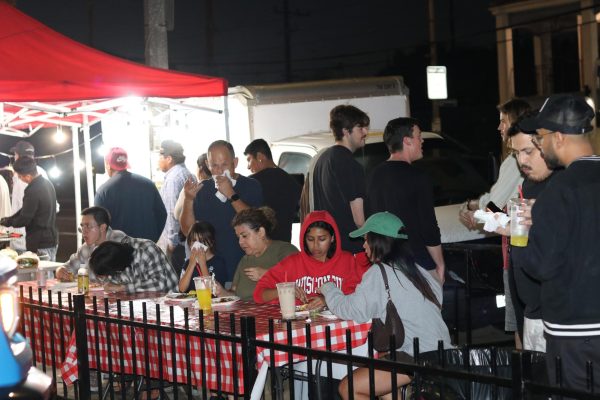
Through a bustling crowd, the aroma of a seared taco and a carne asada burrito floats through the air. The smoky, grilled scent lingers as cars zoom by the tables, lawn tents and makeshift kitchens that line the sidewalks across Los Angeles.
Street food in Los Angeles is a local category of cuisine. Reviews, best spot lists and guides to LA street food circulate the internet and social media. Whether it’s San Vicente Boulevard or Centinela Avenue, nearly 50,000 vendors across Los Angeles sell food or merchandise.
The City of Los Angeles decriminalized sidewalk vending in 2017, establishing a permitting fee of $541. On June 28, 2024, the Los Angeles City Council voted to approve an ordinance reducing the annual fee for street vending permits from $541 to $27.51.
Los Angeles Councilmembers Nithya Raman and Curren Price initiated the motion for a restudy of fees applied to street vending in June 2022. The new price ordinance took into consideration the average annual income of street vendors. The rule aims to decrease the amount of illegal street vending, according to the city website.
“The City Council’s decision to lower the annual vending permit fee marks a crucial stride towards equity and fairness for our vibrant community of street vendors in Los Angeles,” Price said in an interview for the Los Angeles City Council. “By acknowledging the financial realities that these vendors face, we are honoring their hard work and dedication. This ordinance will alleviate financial burdens, allowing more vendors to comply with regulations and cultivate an inclusive, supportive environment.”
Ken Lee owns a Korean street food stand located on Lincoln Boulevard and previously owned a restaurant, Kings Garden, in Chicago. Lee said his stand aims to bring authentic Korean food to the streets of Los Angeles. Korea has a background and abundance of street food that often goes unrecognized in Los Angeles, he said.
“It is the first time that we are doing Korean street food,” Lee said. “We are trying to bring out authentic Korean food as well as a fusion version of it, because Korea has a lot of street food, and people are not recognizing it, so we are trying to promote that as well.”
Oscar Cerventas is a monthly street food connoisseur and chef in Los Angeles. He has worked in fine dining at restaurants such as Nobu, Heirloom and Patina group. Cerventas said he is very experienced with street food culture, having grown up in Long Beach. Street vending felt foreign compared to the restaurants because of the inconsistent and unreliable aspects, he said.
“It seems to me like the wild west. I mean, you are out in the elements. There are a bunch of street vendors popping up, and some will be busy and others won’t,” Cerventas said. “It’s really hard to tell. Then we had the last couple of years of COVID-19, and shifting to different restaurant cultures and different restaurant styles. With how many restaurants went to outdoor dining and then kind of expanded themselves, the service style just went in a completely different direction. It’s just too wild for me.”
Cerventas has set up for catering events, but never worked in a scenario where the turnout is unknown. Being put on the spot appears as nerve-racking and a considerable amount of work, Cerventas said.
“If you have ever set up for an event that is ongoing, you’ve got to have a head count. You have to know what you are going to be doing, serving and parsing out,” Cerventas said. “That’s a lot of work already, but as a street vendor, you never know what is going to hit, what is not going to hit, and to be prepared for it all, it’s got to be really tough.”
Lee said the work and time put into street vending often go unnoticed. The commitment to a full seven days of work doesn’t immediately occur to newcoming street vendors.
“I don’t think it is good for everyone. I am open five days a week, Wednesday through Sunday. This is a full seven-day work, because on Monday I’m picking up all the supplies, Tuesday I do all the prepping, and basically, it’s seven days of work,” Lee said. “It is really very tiring. If somebody actually thinks about it, they have to prepare themselves for really rough work because it is very difficult.”
Sophomore Phoebe Miro eats street food once every couple of months. Miro has recently eaten at Unica Birria, Kogi and Brother’s Cousin. There are common preconceived notions about street food, but Miro said that those assumptions are inaccurate. She said that instead of believing rumors, it is important to try the food first.
“There is a misconception that street food is all bad or is some crappy stuff that you get on the way home from a game or something,” Miro said. “I think it is honestly better than some of the restaurants that I’ve had in LA.”
Street food in the Los Angeles area is everywhere. Driving down Lincoln Boulevard, over 11 separate street food stands line the sidewalks. Every stand represents an individual’s livelihood and dedication to the community, Lee said, and acknowledging the hard work that goes into the job is important.
“It’s not as easy as people think,” Lee said. “When I looked at people selling on the street before I set up this business, I actually thought, ‘Oh, okay. It’s not that hard,’ but when I did it myself, it was very challenging. So I would say it’s not for everybody, but if somebody wants to challenge themselves, I definitely would recommend it.”


Elisabetta Silveri • Apr 30, 2026 at 8:34 am
this is so cool, so proud of you for always finding the coolest angles
Izzie Erickson • Apr 30, 2026 at 8:33 am
Loooovvvveeee this ally!!!
Laura B. • Apr 29, 2026 at 6:45 am
Another great article, Ally! It is engaging, very well written, and informative! Keep up the good work!
Arissa Lalani • Apr 28, 2026 at 11:59 am
Ally, this is such a great story! Amazing work!!