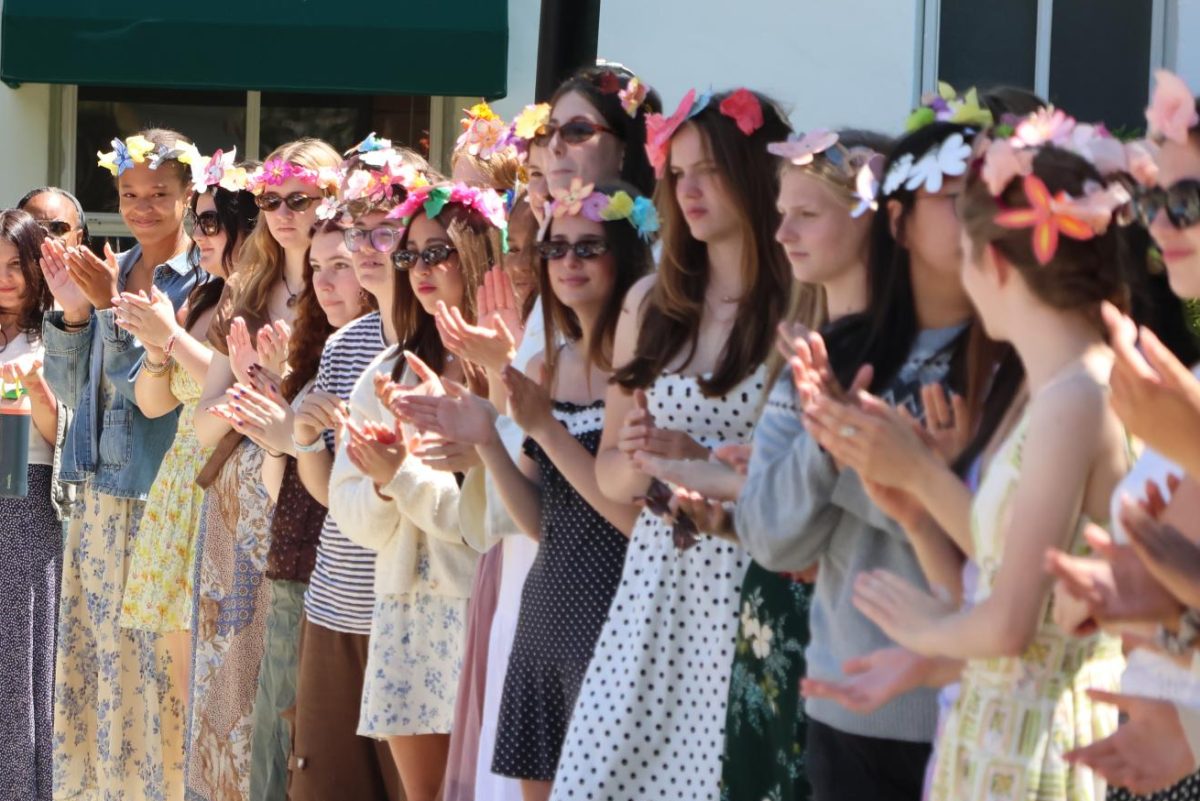

Students across campus carried pocket‑sized poems Thurday April 29, as part of Poem in Your Pocket Day, an annual celebration that was created in 2002 by the New York City Mayor at the time, Mike Bloomberg. Baskets of printed poems — from William Shakespeare to Walt Whitman — passed out to students. The goal, Emerson Cohen (’26) said, was to bring poetry off the page and into everyday conversations, turning the entire campus into a space for reflection and literary engagement.
As a student in English Teacher Kathleen Keelty’s creative writing class, Cohen said that Keelty initiated the celebration at Archer. Each year, Keelty and the creative writing class choose and print the poems.
“As a class, we spent a couple days first finding poems that we loved and that we thought would fit the grades we were assigned,” Cohen said. “We compiled all of them, cut, printed, sorted them and then passed them out to the different classes.”
Cohen said her interest in poetry and literature stemmed from her ninth grade English classes, where having a space for discussion helped deepen her engagement with reading. Now, as she prepares to attend college, she plans to continue that passion by double-majoring in English and Music.
English Department Chair Sara Rubin said she sees Poem in Your Pocket day as a deliberate interruption to the fast paced nature of school life. By placing poetry directly into students’ hands, she said the day invites a different way of thinking and connecting.
“What I find special about Poem in Your Pocket day is that it’s a moment not only of asking people to slow down and think of a different way of communication, it is also an opportunity for connection because people get to share the poems in their pocket with each other,” Rubin said. “To have the physical copy, although you may not be memorizing the poem for that day, you are the mouthpiece for that writer.”
Beyond the day itself, Rubin said poetry also holds a deeper cultural significance because it serves as a cultural reminder that not everything needs to produce a result.
“What makes poetry special is that it refuses to be productive, efficient or part of one of the tools of capitalism,” Rubin said. “It defies that and it invites us to see the world in a way that isn’t controlled by a need to produce something, but rather just see things more freely and less logically.”
For Chloe Kirk (’26), that invitation can also become something more personal. Kirk said, to her, poetry is both a creative art form and an emotional outlet that has been shaped by her experience in the creative writing classroom.
“I find that it allows me to process emotions that I wouldn’t be able to otherwise and also connect with other people in the arts,” Kirk said. “I’ve definitely learned a lot being in creative writing this year because having it as a class means that you have to constantly be working on your craft, and you can’t just wait for inspiration to strike.”
Drawing on insights from writer Stephen King, Rubin said reading poetry and creative writing allows students to engage with voices from the past, making literature feel more personal and alive.
“I think about Stephen King’s thesis on poetry. It is the only form of time travel that we have,” Rubin said. “Here we are, reading the words of someone else and we’re hearing it in our mind and we’re seeing the things that they’re describing to us or imagining them. It’s a form of magic, basically, to have that interaction or that conversation with someone who may literally be dead or certainly is not physically present.”