-
Phoebe Gustafson (’27) stands gazing at a canvas print made by Max Speck (’26). The piece focuses on Speck’s emotions surrounding his teeth and how others view them, aligning with his gallery’s general theme of identity and self-understanding. “They’re all meaningful in different ways,” Speck said. “This one is titled ‘Fix Your Teeth.’ It’s a reflection upon … not having all my teeth and all the negative things I’ve been told about my physical appearance to that.”
Photo credit: Vivianne Arnold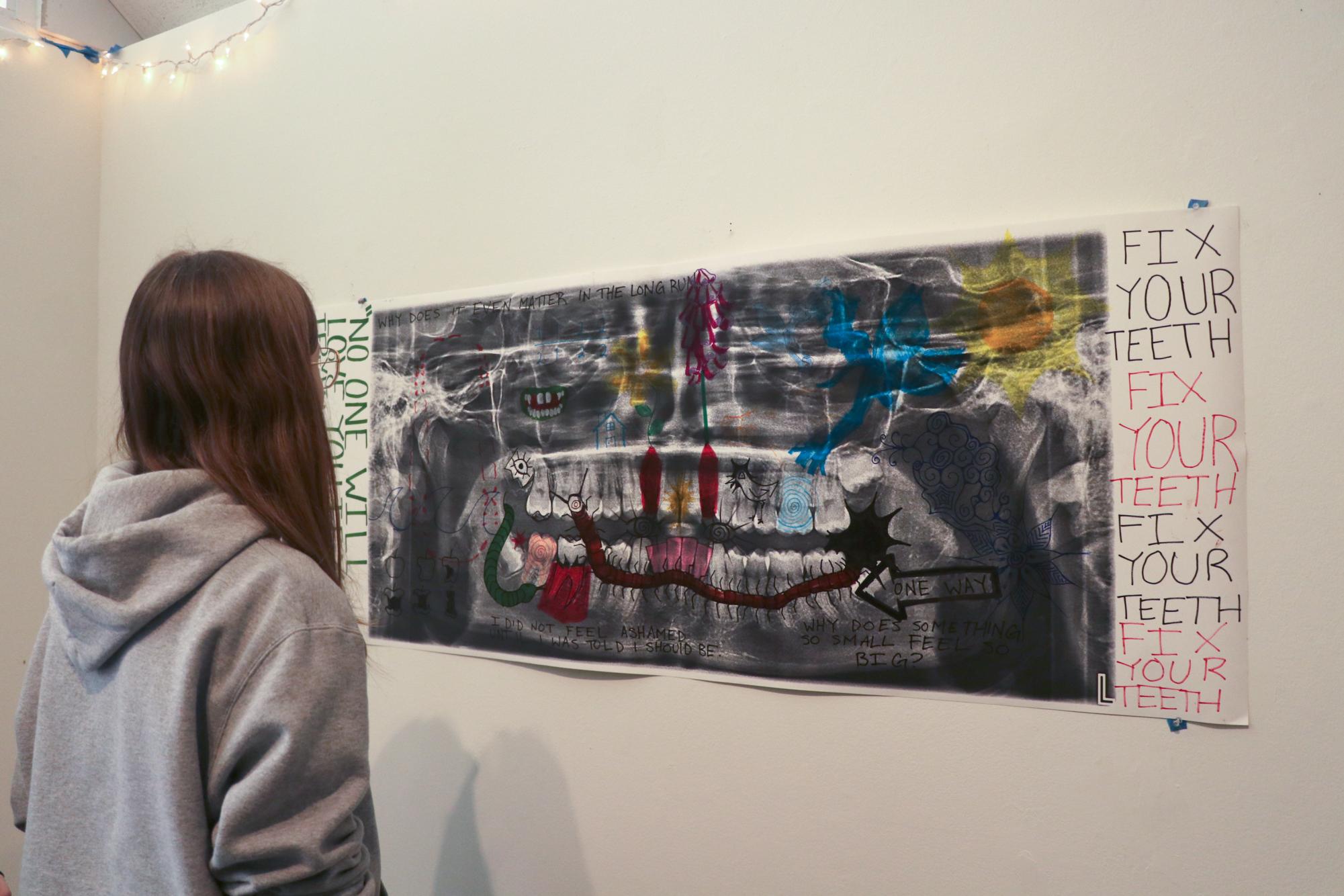
-
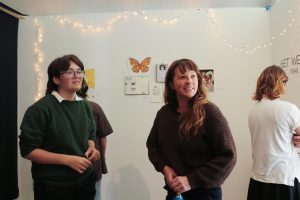
Speck stands holding his painting, which depicts a ram whose horns have grown into its eyes. Speck said it was his favorite piece from his side of the gallery. “Yasmine and me both — we both focus very deeply on the personal meaning, and I think that we both want people to take away that all art has meaning,” Speck said, “regardless of whether or not it’s apparently obvious to the viewer.”
Photo credit: Vivianne Arnold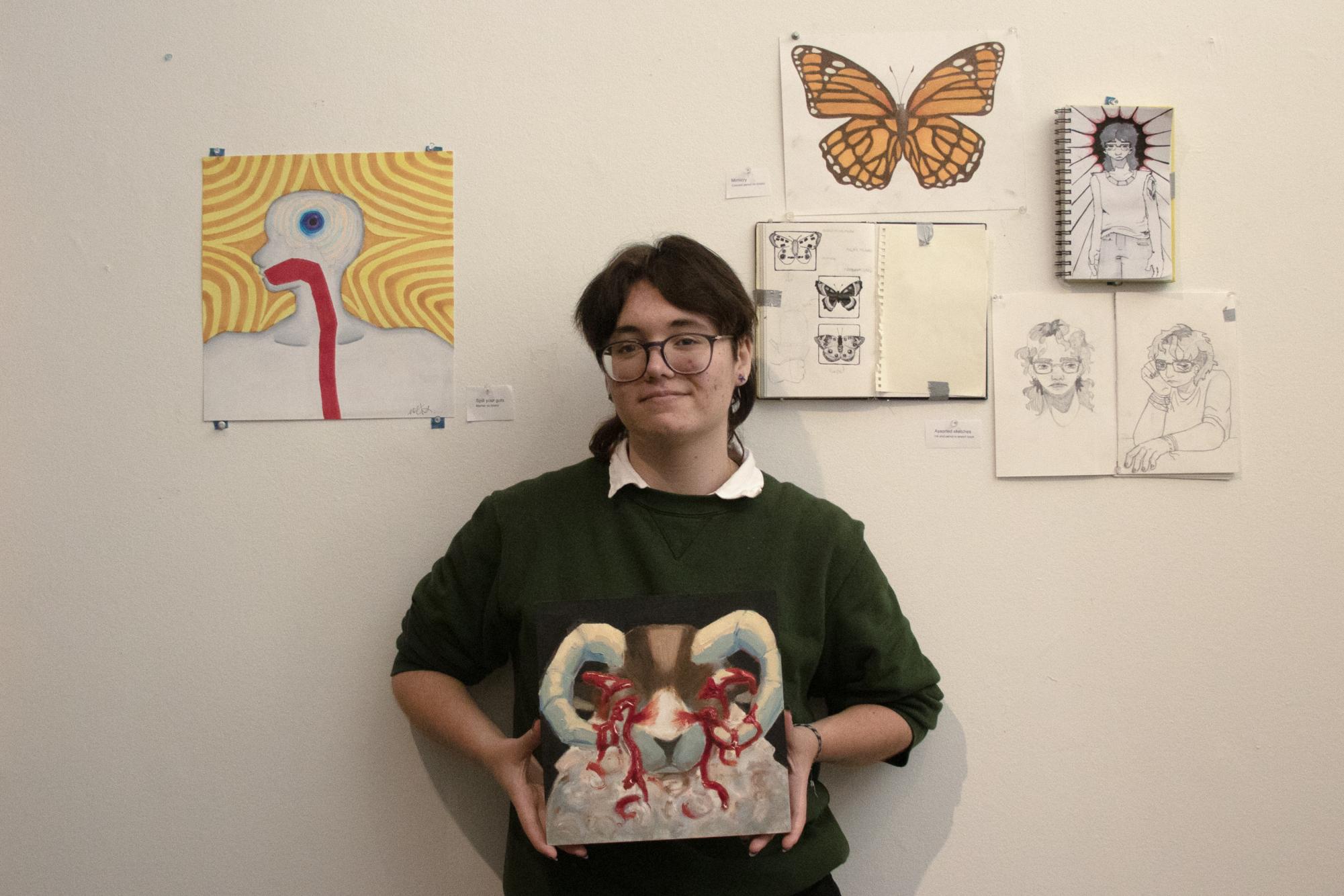
-
On one side of the divided gallery, Yasmine Haddad’s (’26) senior show, “Daw: Light in Darkness,” is etched on the wall. Haddad said her theme developed organically as she began to recognize the personal significance of her, with some pieces drawing directly from her family’s history. “This theme sort of came together only naturally because I made it for myself” Haddad said. “Rather than just rooted in my identity and my culture, it’s specifically rooted in my family.”
Photo credit: Vivianne Arnold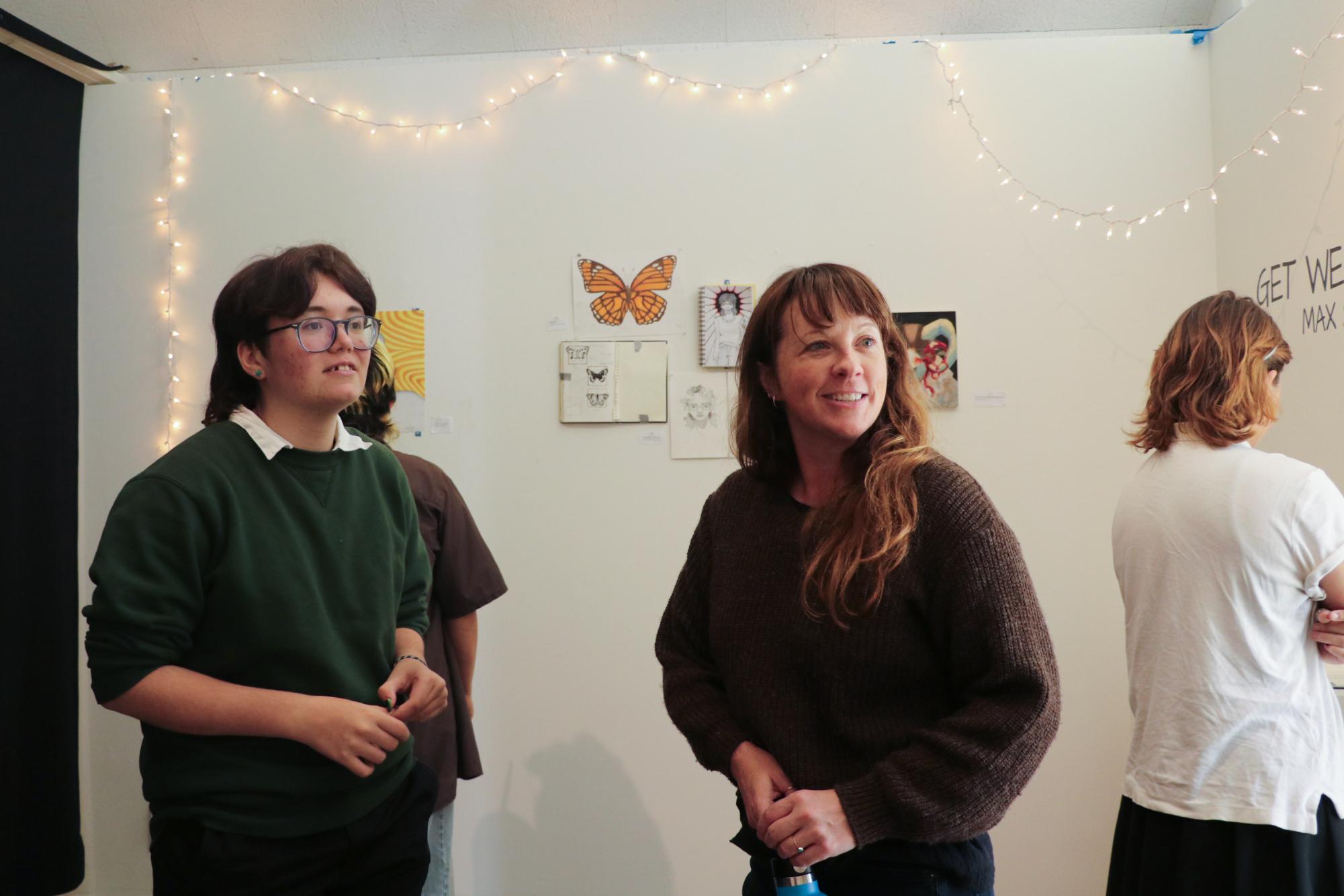
-
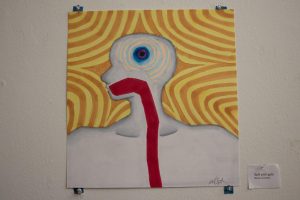
Speck’s piece “Spill your guts” hangs on the wall of the gallery. It is one of many pieces in Speck’s section of the gallery dealing with complex and negative emotions. “It’s very evident that he’s exploring this inner voice and this internal dialogue and how he’s come into his own,” Kremin said, “and I think that just is so evident and screams aloud in his work.”
Photo credit: Vivianne Arnold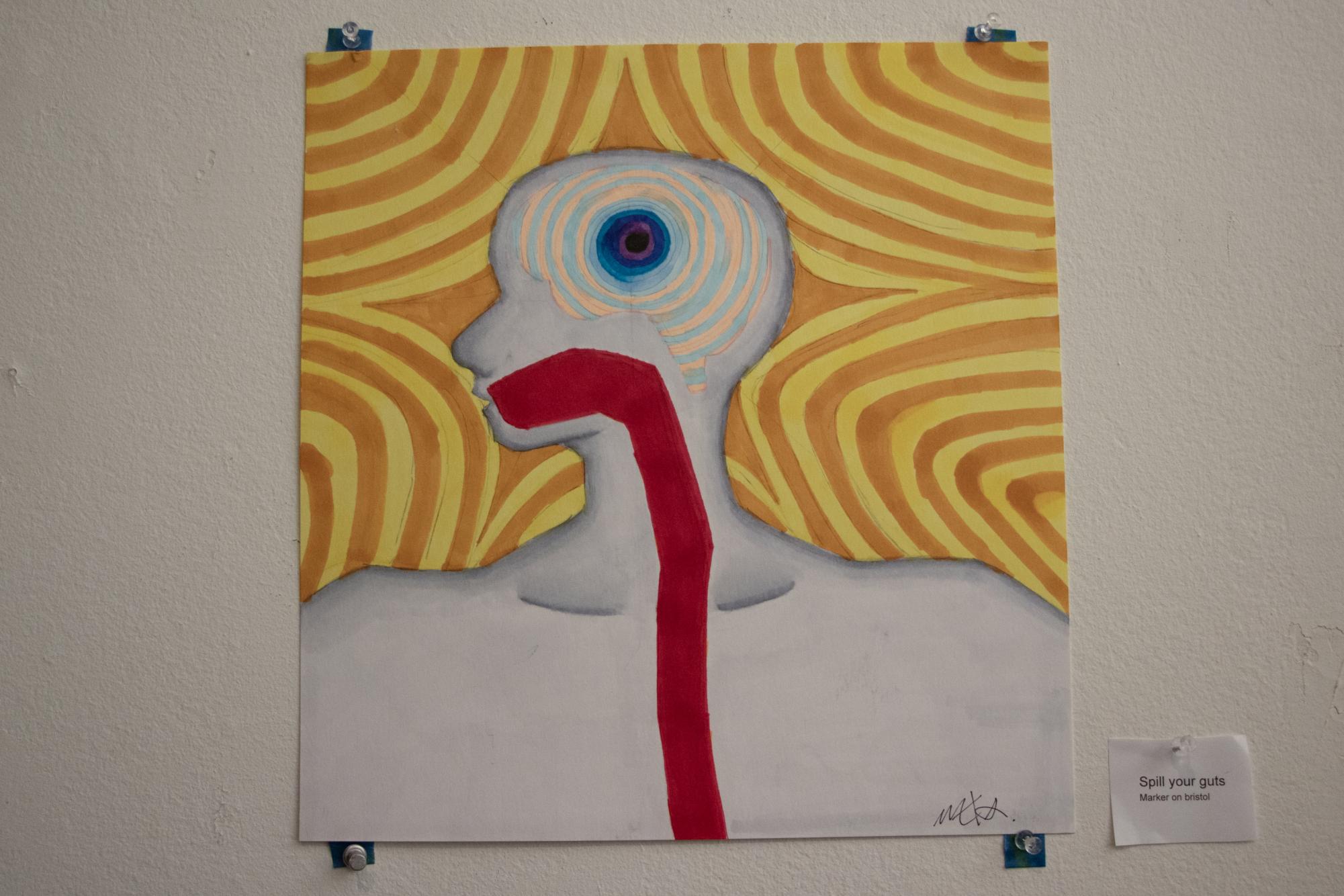
-
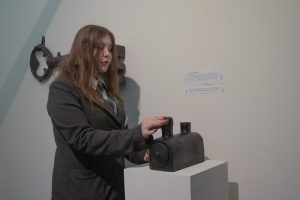
Haddad stands next to the model train she made, which gallery viewers could blow into to produce a whistle sound. Haddad said the technical parts of the gallery were the hardest for her. “Just figuring out, as you go, what’s going to work and what’s not going to work,” Haddad said. “Sometimes it doesn’t work … It’s part of the process.”
Photo credit: Vivianne Arnold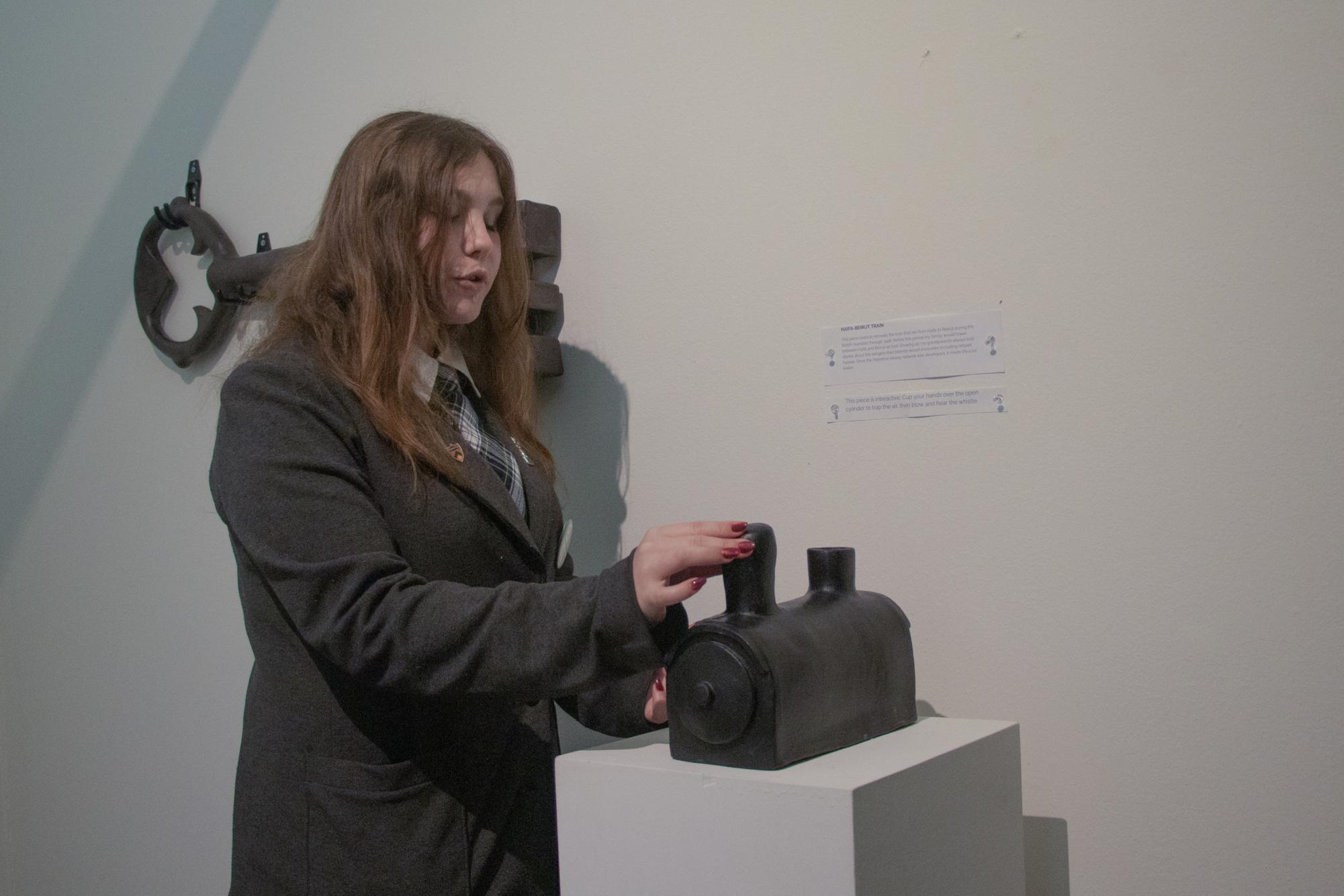
-
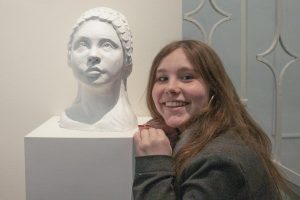
Haddad poses next to the bust she made as a self-portrait of herself. Kremin said she admired how much of themselves both Haddad and Speck poured into their artwork for the gallery. “There’s so many things she’s trying to talk about and a lot of political undertones, and then there’s also her really speaking to her culture and highlighting that, which I think is so beautiful,” Kremin said. “They both totally just scream who they are in their own identity.”
Photo credit: Vivianne Arnold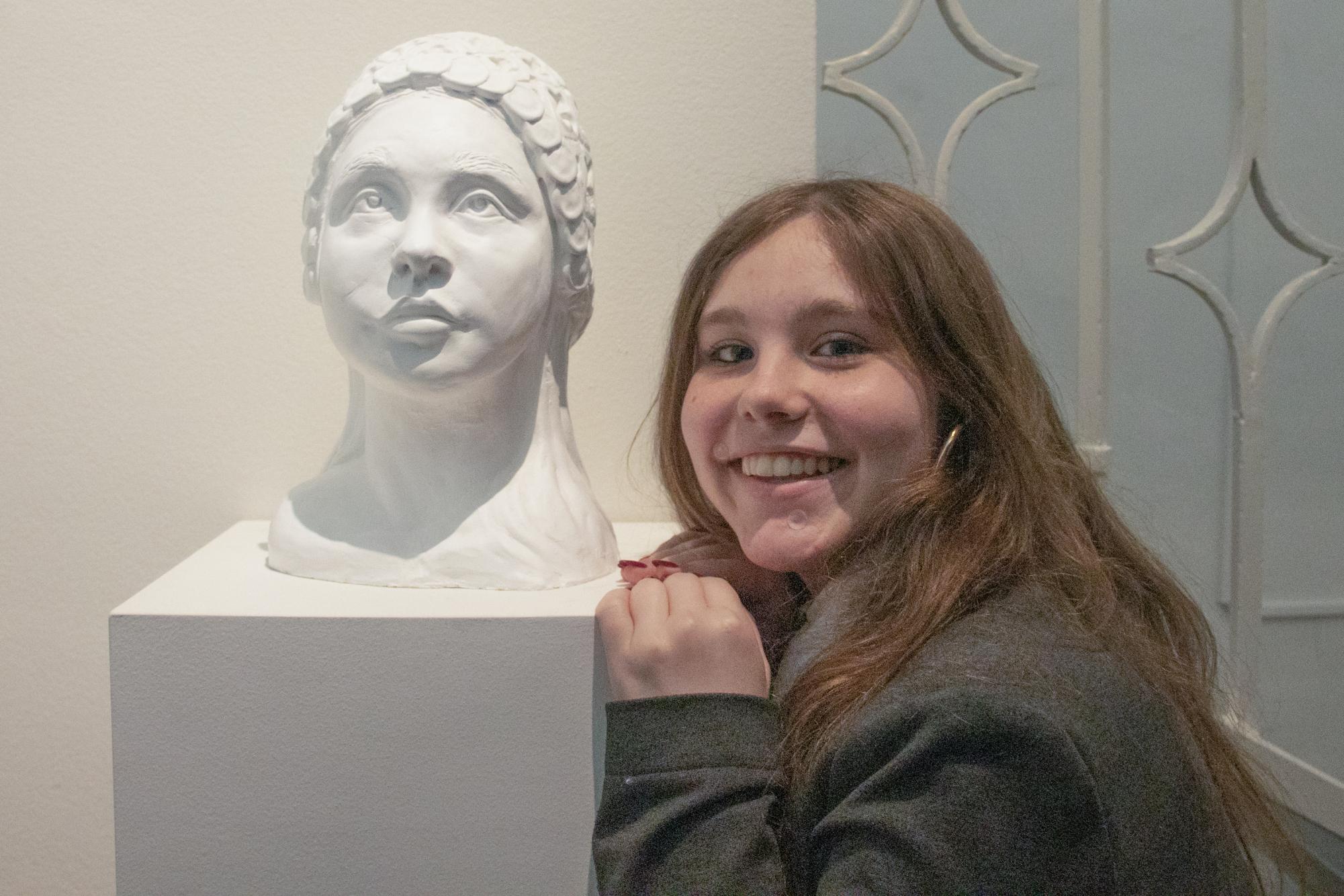
-
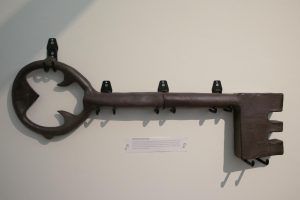
In “Waiting for Return,” a giant clay key hangs on the wall. Haddad sculpted the key to represent a standard iron key to an old Palestinian home. “I hope that they can see that no matter what, how you identify, what your artistic voice is and what you’re interested in — what you’re trying to say, it’s valid and it’s valuable, and people are interested in that, and want to hear that and see that,” Kremin said. “Two very different artists and very different types of work can exist in the same space. They come together. … even though the work may not have much in common, as artists, their personalities have a lot in common.”
Photo credit: Vivianne Arnold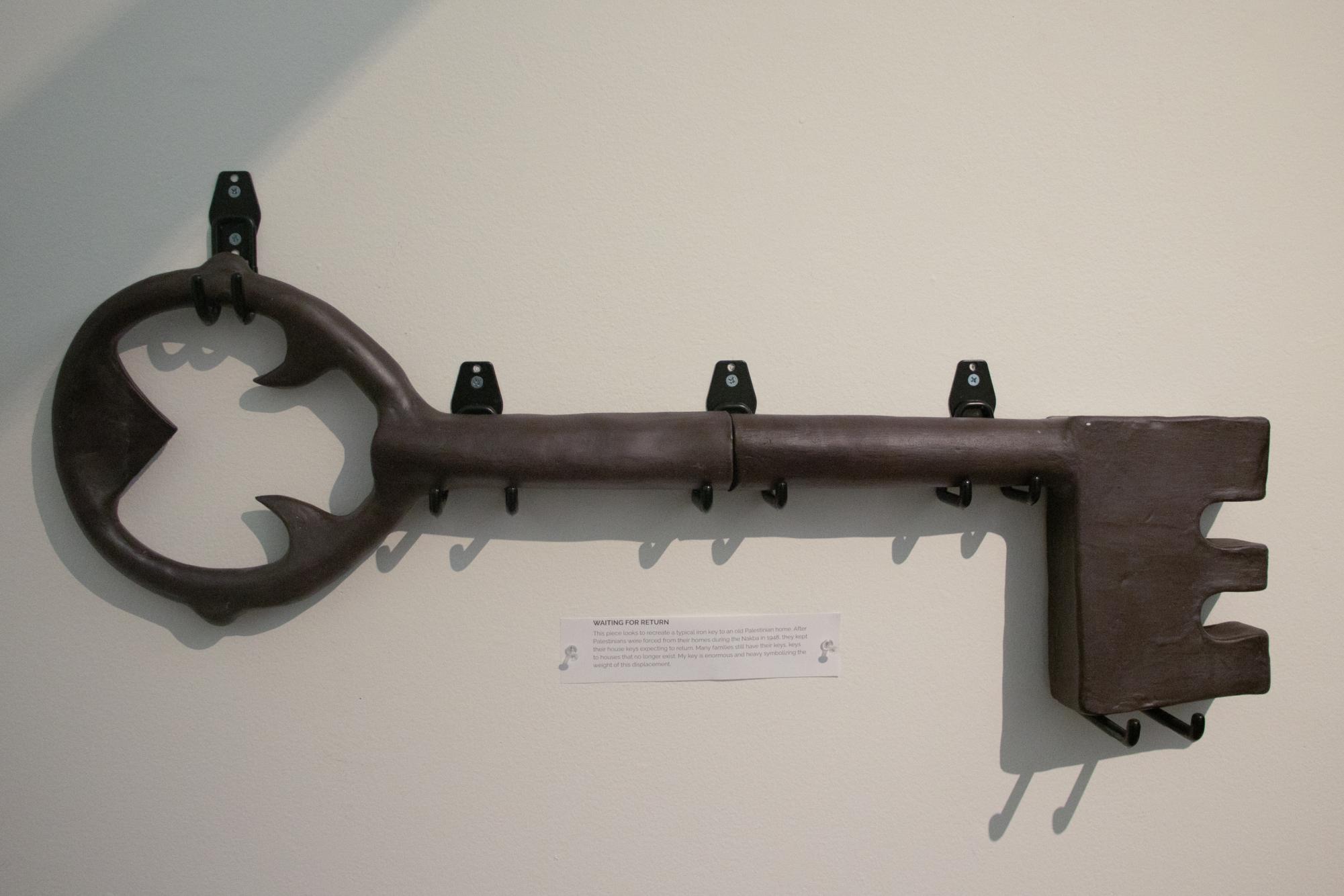
-
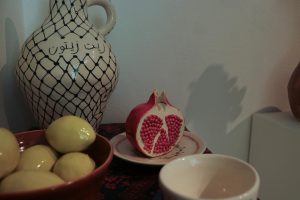
A sculpted pomegranate, bowl of lemons and vase sit on a table. Haddad said she finds it a difficult time to be Palestinian, and she uses the art in her section of the gallery to process her own emotions. “This theme sort of came together … naturally, because it’s just what was helpful for me to make for myself,” Haddad said.
Photo credit: Vivianne Arnold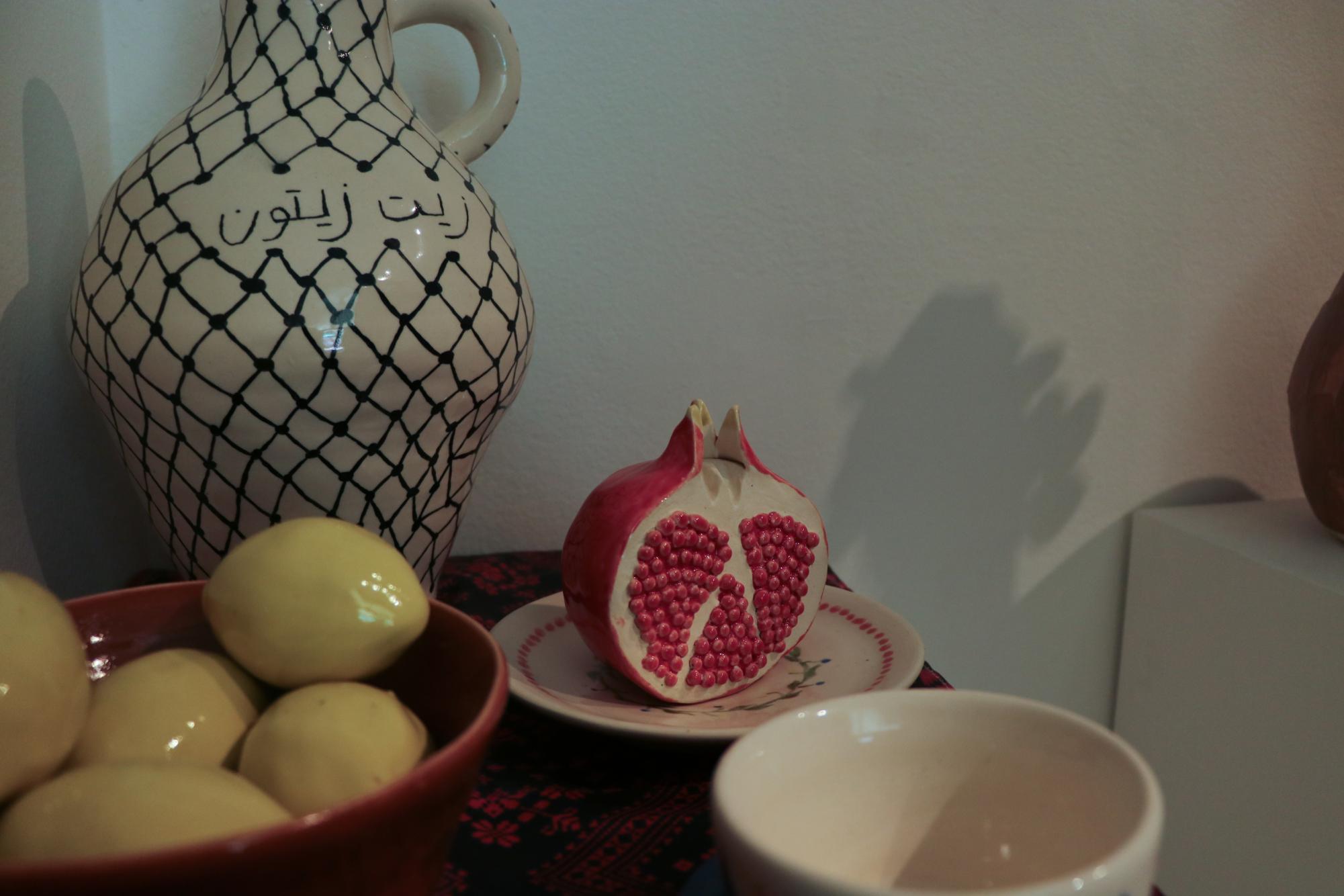
On a sunny day in the courtyard, students and teachers entered the Eastern Star Gallery to see how two seniors transformed the space into a collection of deeply personal work centered on identity, culture and self-expression.
Max Speck (’26) and Yasmine Haddad (’26) presented their senior shows, titled “Get Well Soon” and “Daw: Light in Darkness,” April 29. While the artists shared the same space, the gallery was separated into two distinct sections that guided viewers through Speck and Haddad’s artistic journeys. Their work included ceramics, paintings and mixed media pieces.
Studio art teacher and Co-Director of the Eastern Star Gallery Hannah Kremin said the separation was an intentional, curatorial decision meant to honor the individuality of each body of work.
“The work is really different, which is why they chose to separate the gallery with a curtain so it felt like two separate shows as opposed to one,” Kremin said. “They felt very different, and we wanted to give both concepts space to exist fully on their own.”
Speck’s exhibition, “Get Well Soon,” centered on self-exploration and emotional expression, using art as a way to document and understand personal identity over time. His pieces reflected a process of breaking down and reconstructing the self. Rather than presenting a single theme, Speck said his work reflected a collection of moments that built toward a larger understanding of who he was, transforming internal thoughts and experiences into expressive forms.
“My gallery theme is primarily based upon more melancholy feelings,” Speck said. “A lot of my art is a way for me to express the things I can’t necessarily express verbally. A lot of my art has deeply personal meanings that aren’t always obvious to others.”
On the other side, Haddad’s exhibition, “Daw: Light in Darkness,” took a different but equally personal approach, focusing on cultural identity, memory and visibility. As a Palestinian-American artist, she drew from her experience in diaspora, using ceramics and mixed media as mediums to reflect both personal identity and collective cultural experience. Her work incorporated elements such as light, sound and movement, creating pieces that felt symbolic.
“A lot of this theme is centered around my identity as someone who’s Palestinian,” Haddad said. “That’s a hard identity to have. It helps me feel connected to my family during difficult times and process my own feelings, and creating works like these is really therapeutic and helpful for me.”
Haddad said her goal as an artist was to emphasize preservation and storytelling, as well as create visibility for Palestinian experiences and culture. She aimed to highlight humanity in a world where she feels that identity is often misrepresented or ignored.
“I feel like sometimes there’s a one-sided story and people forget to have empathy for everyone,” Haddad said. “I want to bring back some humanity to the Palestinian experience and show that people can have a little bit more empathy and understanding.
Kremin said both artists used their work to express deeply personal truths, even though their subject matter and approaches differed slightly.
“Max is really exploring his inner voice and how he came into his identity, and Yasmine is speaking to her culture an highlghting that with political undertones,” Kremin said. “It’s two very different artists and very different types of work that exist in the same space.”
Despite the differences in style and theme, both exhibitions shared a focus on art as a form of communication – one that goes beyond traditional expression and becomes a way of understanding the self. For Speck, that meant turning emotional complexity into something visible. For Haddad, it meant preserving culture and ensuring it was seen and recognized within and beyond the school community.
According to Kremin, through the gallery, the contrast in medium and subject matter could be observed, as well as the shared sense of intention behind each piece, and rather than blending into one unified theme, the shows existed side by side as individual explorations of identity, shaped by personal experience, memory and emotion.
Together, “Get Well Soon” and “Daw: Light in Darkness” transformed the Eastern Star Gallery into a space where identity was presented as something constantly being shaped and formed – through art, history, reflection and the act of being seen.
“The senior shows are really a culmination of students’ work over the years,” Kremin said. “It’s a strong way for students to bring together everything they have created.”