

In the interest of full disclosure, Multimedia Editor Melinda Wang (’26) is a member of the Archer Inventing Smart Solutions Class & Club communications team.
When devastating fires struck Los Angeles in January, the Archer Inventing Smart Solutions Class & Club had the opportunity to create a solution that would alleviate some of the effects.
Starting in October, months before the fires erupted, the team brainstormed a wildfire-targeting invention they would dedicate the rest of the year building. They created FREDD — Fire Retardant & Erosion Diminishment Device — during FLX Blocks, lunch periods and weekends.
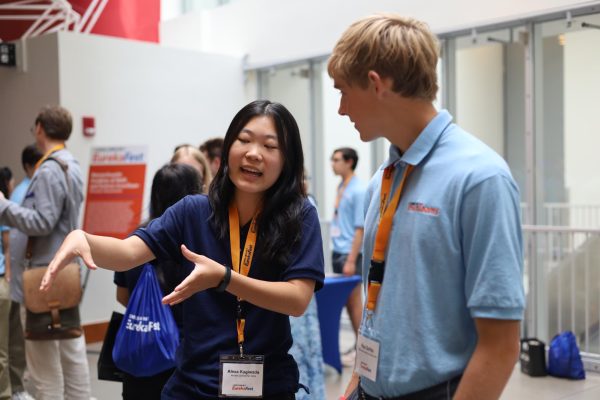
The team recently showcased FREDD’s prototype at Lemelson-MIT’s EurekaFest, a multi-day event where student InvenTeams from around the country present their inventions to fellow students, MIT staff and curious attendees.
EurekaFest took place June 9-11, and Archer’s Inventing Smart Solutions Class & Club traveled to and stayed at MIT’s Maseeh Hall. Nine schools participated in EurekaFest: eight InvenTeams and Archer’s Inventing Smart Solutions Class & Club. After officially being recognized as an InvenTeam in 2016 and 2021, Archer attended as part of the Inventing Smart Solutions class rather than as an InvenTeam, giving other schools the opportunity to participate.
The first two days of the event were for schools to reconstruct a final prototype of their devices and prepare for them to be showcased on the third day. Archer’s Inventing Smart Solutions Class & Club rebuilt FREDD, which was designed to neutralize Phos-Chek, drill into burnt soil and plant seedlings in wildfire-affected dirt.
After realizing that Phos-Chek, a fire retardant primarily used in California, was harming the soil it landed on, the team created FREDD. Programming team member Charlotte Bloomfield (‘28) said Phos-Chek negatively impacts both the environment and humans who come into contact with it.
“In 2025, the Palisades and Eaton fires burned over 37,000 acres of land, and to combat this, people use something called fire retardant, which people know as the red substance dropped from planes,” Bloomfield said. “However, Phos-Chek contains something called ammonium polyphosphate, which can cause respiratory issues, cancer and make plants around it harder to grow.”
FREDD has the ability to neutralize Phos-Chek but was also built for two other processes. Bloomfield said that FREDD drills into the soil to plant saplings after the retardant has been neutralized, using a conveyor belt to drop saplings into the soil.
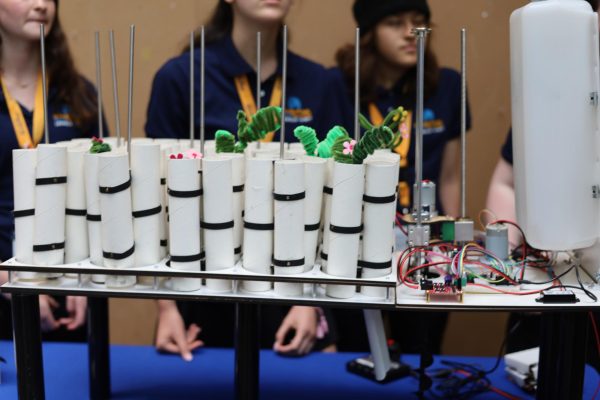
“First, [FREDD] neutralizes. To do this, we reverse chemically engineered Phos-Chek and found that the best fit for a neutralizer was potassium hydroxide or KOH. FREDD releases potassium hydroxide, then that reaction causes ammonia gas to be lifted into the air,” Bloomfield said. “When these ammonia levels are at a low enough amount, FREDD knows it has neutralized a sufficient amount, and it can move on to its drilling system.”
EurekaFest brought many other issues to attention, as each InvenTeam focused on solving a unique problem within their school communities.
Ygnacio Valley High School’s InvenTeam called their invention Dexterra — an assistive mobility glove that aims to assist those who may have lost mobility in their hand. Ygnacio Valley High School student Aniyah Taylor (‘26) said their inspiration came from a student from their school who has limited hand mobility. They spent time observing his daily routine and the types of things that he would need help doing.
“We also had a representative from our school district — who works in a special needs area — and she brought to our attention that a lot of kids, especially younger kids in elementary school, have a hard time interacting with toys, especially those in kindergarten and first grade,” Taylor said. “So that was a really big concern because a lot of these kids don’t have full bodily autonomy.”
Cambridge Rindge and Latin School’s InvenTeam built ROWdar, an invention designed to make rowing safer on the Charles River. Edward Chook (’25) explained that because many students at their school participate in rowing, the team became aware of safety concerns — boats were crashing, and coaches were losing track of students’ locations on the river.
“When coaches know where all their boats are at all times and communicate with them, these risk encounters become far less likely, thereby improving safety,” Chook said. “Because, in the sport, it is said that safety is the number one thing, and then the teamwork, and then the winning part. ROWdar achieves this using a small, single board computer equipped with the GPS that transmits location and audio data to coaches. So the coach uses this data through a web interface and can send messages to coxswains.”
For the 2024-25 year, each InvenTeam was awarded $7,500 with the goal that their inventions would leave a lasting, positive impact on their communities. Many of the InvenTeams are now patent-pending, including Archer.
“We do provide a little financial support in terms of getting them across the finish line for the InvenTeam process. But I would say the majority of the work is done by the students themselves,” Interim InvenTeam Manager Edwin Marrero said. “We provide support and multiple different perspectives to help them get across that finish line of presenting here at EurekaFest. But the majority of the work is student-led, it’s teacher-led — it’s all a culmination of all the support they have in the local community.”
Invention Education Manager Cristina Sáenz, who helped Marrero oversee the event, said she fell in love with invention education during her doctorate studies, inspired by how fulfilling it is to see students give back to their communities through creation.
“[Invention education] is how you make STEM sticky for people who wouldn’t normally see themselves as STEM people,” Sáenz said. “Invention education begins with deeply understanding the problem and having to empathize for the needs of the people that are suffering or that have the problem, and that draws many people who wouldn’t normally see themselves in STEM to STEM.”
Sáenz added that she sees hope for the future after watching InvenTeams at EurekaFest connect with each other and champion each other’s prototypes.
“We’re trying to educate a generation of students, not just with content, not just with formulas or with algorithms, but rather with a process-based approach that teaches students to be able to find hard problems, which is really the difficult part, right?” Sáenz said. “It’s finding problems and having the confidence to know that they are capable of finding solutions to those problems and connecting with people who are deeply affected by those problems.”