


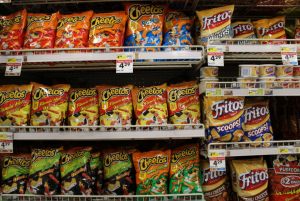
Almost every supermarket has a snack aisle: a long hallway devoted to chips, cookies and candies. Shelves are filled with colorful logos, bright, plastic wrappers and artificial flavors. These treats are ultra-processed and can be detrimental to health. But what exactly are ultra-processed foods?
Before being eaten, most foods are processed in some way — whether through chopping, drying, grinding, freezing or cooking to prevent foodborne diseases. When food undergoes excessive processing, it loses nutritional value, which then affects health. To track and categorize processing, public health and nutrition researchers made the NOVA Classification System. There are four types of food processing levels of the NOVA Classification System, but foods like soft drinks and packaged snacks fall under Category 4: ultra-processed.
Registered dietitian Danielle Huff works with patients to improve nutrition. She said what separates processed food groups like Categories 2 and 3 from Category 4 is that UPFs go through a lot more work to turn into a different form.
“For example, canned fish did not grow in the cans. You had to put it in the cans. Certain oats — maybe quick oats — they had some processing to break them down,” Huff said, “but they’re still at a form that’s pretty close to the natural form. Ultra-processed foods are foods that have gone through a lot of extra steps, a lot of extra-processing.”
This extra processing makes food higher in calories and contains added salt, sugars and fats while reducing fiber and protein, which tend to be filling when eaten. Huff said this imbalance in nutrients makes UPFs easier and more desirable to eat.
Other markers of UPFs are different chemicals and preservatives, according to John Hopkins Bloomberg School of Public Health. Companies put additives into snacks to make food last longer while still maintaining good taste.
“Food waste is a problem for companies,” Huff said, “because if your product is spoiling before people can pay for it, then you lose money. But if you can make it something with a shelf life of a year, that means it’s more likely that people are going to buy it.”
Unlike UPFs, whole foods belong to the first level of processing: minimal to none. Usually, the forms these basic foods are eaten in are the same forms they came out of the ground in or from an animal.
Private practice dietitian and certified lifestyle medicine provider Cynthia Bartok said a nutritious diet is composed of a range of these minimally processed foods, especially plants.
“I really enjoy the new dietary position statement from the American College of Lifestyle Medicine,” Bartok said. “Their position emphasizes two points: having a variety of whole and minimally processed plant foods serve as the basis of the diet and minimizing red and processed meats, foods high in saturated fats, and ultra-processed foods.”
Ultra-processed Foods and Health
Whole foods are not only filled with vitamins, minerals and nutrients the body needs, but also support a healthy digestive and immunity system, Anna Reed, a pediatric gastroenterologist at John Hopkins School of Medicine, said. Intestines have microbiomes filled with normal and healthy bacteria that are made for digesting complex, whole foods.
“When you’re eating a lot of fresh fruits and vegetables and whole foods, you develop a very diverse and healthy microbiome that actually serves as part of your immune system.” Reed said, “and the more complex your diet, the more complex your microbiome, and it forces your gut, the gut lining, to become healthier and more adaptable to eating more complex — digesting more complex things, which promotes immunity.”
When UPFs become the basis of a diet, it leads to a less diverse gut microbiome. This lack of bacterial diversity throws the microbiome out of balance and can cause issues with not only immunity, but also things like abdominal pain, cramping and bloating, Reed said.
A health study and analysis from the National Heart, Lung and Blood Institute also found high intake of UPFs was linked to increased risk of heart disease and strokes in American adults, with 17% greater cardiovascular disease risk, 23% greater coronary heart disease and 9% more stroke risk compared to those who did not eat as many UPFs.
Side effects such as less energy and cramps stem from eating a lot of UPFs, Reed said. While these effects might seem small, they can have a big impact on daily life, as UPF-induced fatigue risks affect the ability to carry out tasks or productivity, according to Lifesum Health.
“You probably will not feel as good,” Reed said. “It could be more difficult to get up and do stuff because you’re feeling sluggish because you’re eating a lot of high-fat and high-carbohydrate foods rather than eating foods that are going to energize you.”
These health effects usually worsen as people get older, as the feeling of simply being tired might develop into issues with blood pressure and cholesterol, Reed said.
Ultra-processed Foods and Labeling
Even with information on UPF health risks availiable online, many Americans continue to purchase and develop unhealthy eating patterns around UPFs, getting most of their calories from these snacks, according to NPR. Albertine Churchward (’32) said she’s always had lessons on food health, but feels a deeper explanation on why certain foods are considered “unhealthy” and “healthy” is needed.
“You just say, ‘Oh, do not eat too much of this’ instead of, ‘Oh, if you eat too much of this, then you’ll be consuming this and this and this, which is bad for you.’ So I do feel like we know not to eat them,” Albertine said, “but we could definitely get a better education on them.”
Government-sanctioned food labeling aims to spread awareness of nutritional health. Food labeling is information on packaged food that is intended to help consumers understand what exactly they are eating. In the United States, all food companies are required to identify the nutrition facts of their products based on a guide made and overseen by the Federal Food and Drug Administration.
A poll taken from Archer asked students how often they buy UPFs and if they thought bold labels in addition to nutritional facts would affect awareness around purchasing decisions.
While food labels can be very useful when grocery shopping and at restaurants, it can be difficult to interpret the numbers, percentages and complex-sounding ingredients, which leads to labels causing more confusion than clarity, according to The Nutrition Source.
“When you look at a food label, and it gives you the amount of protein or saturated fat or iron or whatever, you look at that, and I think a lot of people think, ‘Oh, okay. I do not know how to interpret that,” Reed said. “That’s the contents of the bag, but I do not know — is that good? Is that bad?'”
As a dietitian, Huff said labeling does help her make decisions on what to eat, but it is not necessarily as helpful as hoped to be.
“Unfortunately, I think the research shows it does not make a huge difference,” Huff said, “because when you’re used to seeing it so often, I think people kind of start turning a blind eye.”
As labels start to lose utility, certain online apps, like Open Food Facts and Yuka, have made pathways that help people easily understand what nutrition facts state. These apps search and scan food products to compile information about the nutritional quality and ingredients.
“I do believe it would be helpful to have some labeling laws related to processing to help guide consumers at the point of purchase,” Bartok said. “That said, in the absence of these laws, many phone apps have stepped in.”
Ultra-processed Foods and Accessibility
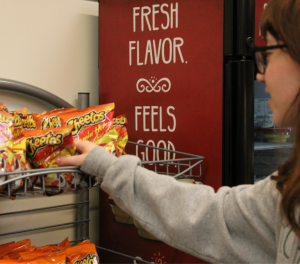
Lack of understanding of nutritional facts is not the only reason people keep buying UPFs; economic and geographic factors also play a role in how much someone can cut UPFs from their diet, Reed said. While UPFs like prepackaged snacks, sodas and candy are not great for health, they are more affordable and accessible than their whole-food counterparts, as it is much cheaper to make something in a factory than grow crops.
“The other thing that we really have to think about is that whole foods are very expensive, and the reality is that in our country right now, there are many families that can not afford to eat healthily,” Reed said. “That is why when you look at data on obesity and ultra-processed food consumption, we do see that families that are socioeconomically disadvantaged proportionally eat more of those foods because they are cheaper.”
Given the various factors that affect people’s diets, there are still many simple methods to reduce UPFs. Suggestions include setting achievable goals and focusing on adding more fresh foods into meals rather than limiting the amount of UPFs, Huff said.
Ultra-processed Foods and Simple Methods to Reduce Them
“If you’re focusing on what you’re adding in rather than what you’re removing, you’re less likely to feel deprived, which should help make the process easier. Once you’ve successfully incorporated your new goal into your daily life, try setting a new goal,” Huff said. “Eventually, you may find that UPFs have mostly been phased out as your taste buds become accustomed to your new choices and your body starts feeling the benefits.”
Churchward said she can see her school community already starting to implement these practices in their daily lives. A way she and her friends keep track of UPF intake is to regulate how many times a week they eat certain sweets or snacks from the servery.
“I think that a good ratio is to always have more healthy food than you do ultra-processed,” Churchward said, “and, once or twice a week, you can have something a little bit on the less healthy side.”
Huff said focusing on having more minimally processed foods is a habit that will improve life in the long-term.
A rabbit hole many fall into is feeling shame from eating these UPFs; diet culture has had a big influence on what “healthy eating” is and how those eating habits contribute to a desirable physical appearance, according to Innovative Resources. Huff said it is not about having a perfect diet — it is about balance.
“I think the overarching goal should be when you look at your diet over the course of a week, it should be mostly healthy. I think moderation is okay,” Reed said. “In an ideal world, these foods would have never been invented, and we would not have this problem, but that’s not the reality, and so we all do the best that we can.”