Six judges, 12 students, two rounds — weeks of practice led up to this moment.
Archer’s new take on competitive poetry recitation invited students to the Zeller Student Center Feb. 18. Archer competed annually in Poetry Out Loud since 2020, but alterations and the removal of poems and poets like Maya Angelou, Gwendolyn Brooks, Audre Lorde, Rita Dove and other poets of color from their website led Archer to put a pause on participating. Invested students and faculty members Selah Johnson (’26), Adella Travers (’27), Phoebe Gustafson (’27), Frankie Scott (’27), Samara Gottlieb (’28) and Vivi Arnold (’26) collaborated to create their new competition: Poetry Allowed.
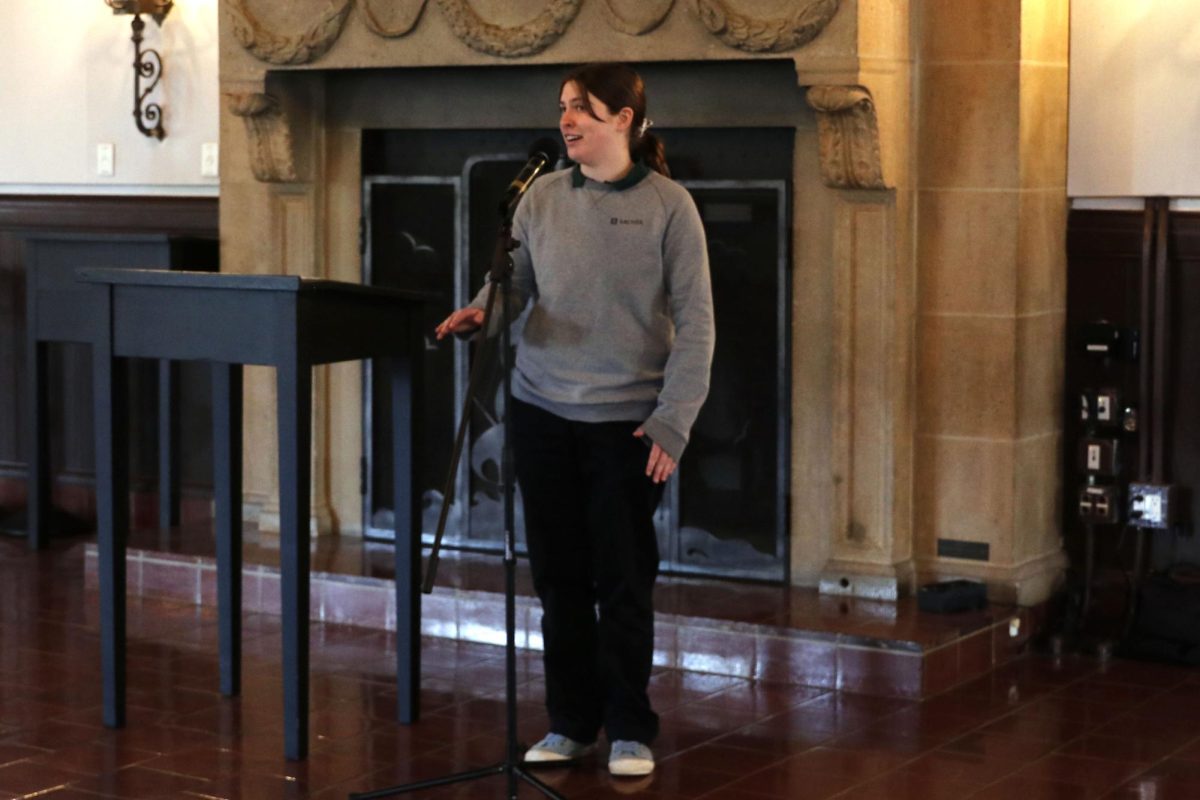
The first round began with each participant performing a poem of their choice as the monitor behind them displayed that poem. One by one, they took turns reciting their poems as they chose to interpret them. A total of 12 student voices, with a few competitors on video, echoed throughout the room. Though the main event took place on Wednesday, the participants had been practicing their poems for weeks prior.
English teacher and judge Kathleen Keelty brought Poetry Out Loud to Archer in 2020, having already worked with the organization for a few years. Keelty has now taken on the management of Poetry Allowed with the help of students.
Keelty said she believes poetry and the arts need to be included in all curricula to foster creativity and understanding. She said poetry allows students to find their voice and connect with others through shared experiences.
“This is important is because I think there are a lot of students who don’t know that they have a love or passion for poetry and performance until they try it. And I also think that poetry is this short form of art that allows you to read. You can read a lot of it and see what resonates with you, what makes sense to you,” Keelty said, “but everyone can find a poem that can sound like it’s their voice speaking. Everyone can relate to something that a poet is talking about.”
Poetry is a language of deeper meaning, where the literal sense is only one doorway, Keelty said. She feels poetry is a language that has a deeper meaning, where the literal, direct meaning doesn’t have to be how someone interprets it — it is how the poem makes the person feel that matters.
“Poetry means a lot to me because it is condensed language that creates meaning,” Keelty said, “but the meaning is really up to the person who’s reading the poem, who’s listening to the poem.”
Tenth grader Clara Lieberstein reflected on the importance of poetry. She said the unfortunate change in Poetry Out Loud has only led to greater opportunities. The approach Archer took towards a level of serious censorship was an appropriate and informed response to issues of oppression and restriction, Lieberstein said.
“We didn’t only pull out our participation from Poetry Out Loud, we also started our own initiative that continues to empower student voices,” Lieberstein said. “Instead of just boycotting and voicing our displeasure with oppressive systems, we create new ones. And I think it’s just a very powerful sentiment.”
Lieberstein discussed the importance of the spoken word. She values poetry for its role in adding a new layer of power and perspective, allowing for various interpretations.
“Reading it out loud gives you a whole new perspective on a written work,” Lieberstein said. “I think the beauty of spoken word poetry – is that so many people can interpret it in so many different ways — I think that adds a new layer of power and perspective to poetry recitation.”
Keelty said it was necessity for students to have outlets to express who they are. She believes this curriculum should be accessible to everyone and taught in all schools.
“When we don’t teach poetry, we’re depriving students of exposure to a beautiful art form that they may find that they love,” Keelty said, “and poetry helps people to see and understand other people and other perspectives.”