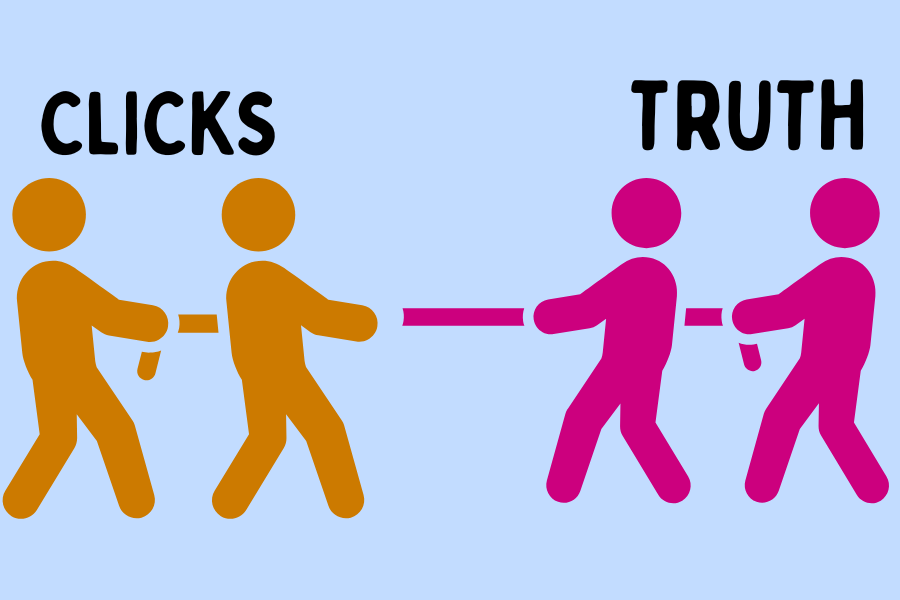
Kicking off this year’s National Scholastic Journalism Week, JEA describes the first day’s theme, “Don’t Fold Under Fake,” as a rally for journalists to seek out truth and resist pressure to sensationalize in their reporting.
Dramatized stories often rely on dramatic language, out-of-context facts or claims designed to capture readers’ attention. For journalists, being able to identify these tactics is crucial as it helps to understand the danger of employing them in their own reporting. Rather than amplifying rumors, responsible reporters seek truth to avoid causing harm.
Irene Park is a senior at Sunny Hills High School in Fullerton, California, and the co-editor-in-chief of The Accolade. When there was a bomb threat at her school in November 2025, Park took the lead in covering the breaking news, writing a piece that won a Best of SNO award. Park said she meticulously corroborated her information while writing this time-sensitive article.
Despite the scale of the event, Park said it is always essential that each individual reporter on any publication verifies their facts.
“Not just for the reputation of your publication, but also just as a genuine person who’s trying to help people … it’s really important that you take the proper steps to information to ensure that you’re not causing more harm,” Park said. “I think ‘Don’t Fold Under Fake’ is just making sure you know what you’re doing and that you’re also aware of the consequences … you better be ready for whatever comes after.”
Similarly, editor-in-chief of Tideline News Sophia Winston said she and other staff members at Palisades Charter High School had to balance personal impact with journalistic responsibility when covering the Pacific Palisades Fires in January 2025.
The fires destroyed around 10,000 houses and businesses across the Palisades, Malibu and sections of the Santa Monica Mountains. Amid the wildfire, nearly 35% of Palisades High School was destroyed. Students temporarily studied at an old Sears department store building throughout the rebuilding process and returned to school one year later.
“We first had to be conscious about the staff members in the Tideline because we all go to Pali. We had to make sure everyone who was just part of our publication was okay — willing to talk about this, willing to go and ask people about it — just because it directly affected all of us,” Winston said. “We weren’t really seeing it from an outside point of view. We were also living through it.”
Once Palisades Charter High School students returned to campus, many community members worried about students’ safety, as the school did not use the Environmental Protection Agency’s TO-15 method to measure levels of volatile organic compounds inside enclosed buildings. Winston wrote a feature about these concerns and said she prioritized extra fact-checking to avoid sensationalism, while accurately capturing the community’s desire for more transparency from the school administration.
“A lot of my article was different research and looking at documents and records and things that were rooted in fact, so I knew I wasn’t incorrect,” Winston said. “Not only because it can put you, as the journalist, at risk if it’s incorrect, but it could put your entire publication at risk. It could put the people that you include in your article at risk because they could be associated with misinformation.”
Another LA high school publication, the Ultraviolet at Marlborough, also values truthful reporting. Social media manager Penny Franklin said Ultraviolet checks their facts by using a minimum of six editing rounds: two from section editors as well as additional edits from the co-editors-in-chief and adviser as needed.
“I think just tracing back through the grapevine to see where something originated to fact-check is definitely helpful,” Franklin said. “Whether it’s a claim made about the school, or a certain person, just going back to where it originated … Even if we haven’t come to a conclusion, our first job is to report the facts and what we know as to what’s true and what’s not.”
Winston said the spread of misinformation is often inadvertent but still dangerous.
“I always want to go and check that it is true from the source directly,” Winston said. “People can hear things, and they may not even be intentionally trying to say something that’s not true, but things get twisted when they’re spread around.”
Additional reporting by multimedia reporter Christina Williams (’27).