


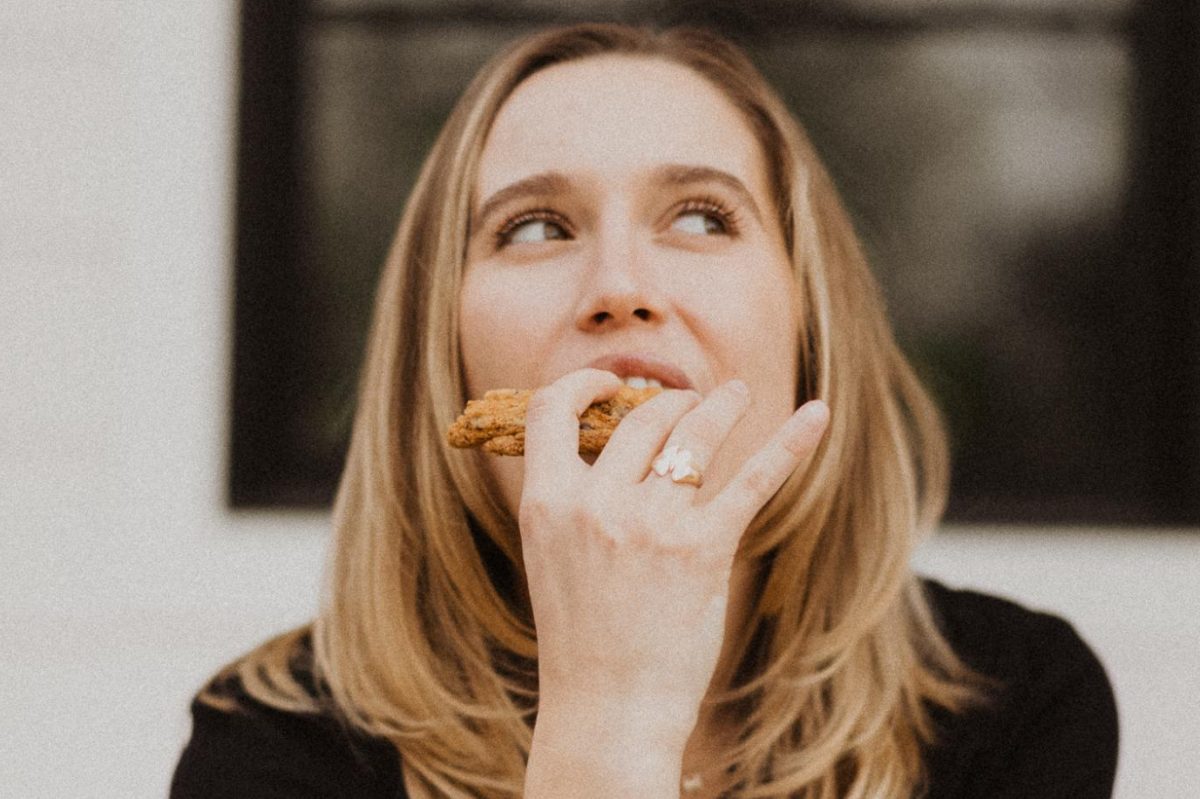
When most of us hear “dietician,” we might think of strict eating guidelines, an emphasis on bodily transformation, and maybe, goals of weight loss.
For Mallory Page, a registered dietician, this couldn’t be further from the truth.
To name just a few of her many contributions to her field, Page is the founder and CEO of Live Unrestricted, a virtual program that guides clients on a journey to food freedom, intuitive eating and body acceptance. She founded Freedom from Food Noise, an audio course that aims to quiet clients’ food noise. Page describes food noise as consistent and overwhelming stream of thoughts about food, noting that it manifests differently for everyone, but often feels inescapable. She supports other practitioners in adopting elements of her non-diet ideology through the Live Unrestricted for Practitioners program, and she hosts the weekly Seems Like Diet Culture podcast, which dissects health fads, examines harmful dieting trends and offers strategies to move towards lasting body acceptance. Page’s work is especially meaningful during our current period of diet culture extremity.
I was honored to sit down with Page and discuss the ways she is redefining the purpose and practice of her field.
Can you give a brief overview of the work you do, what led you to it, and why it’s meaningful?
Mallory Page [MP]: I always say I got into my role for the wrong reasons, but it led me on the right path because I was in high school and started struggling with — what I didn’t know at the time was — an eating disorder. And part of the reason why I didn’t know it was because I was dealing with orthorexia — which still isn’t even in the DSM-5, technically — and that’s essentially an obsession with health to the point that it becomes unhealthy. So everyone in school and my coaches were telling me I was doing such a good job, and I was so disciplined, and I just thought, “Well, I might as well go to school to help other people eat healthy,” and that’s what led me to become a dietician. But on the journey of schooling, I then realized that what I was doing was not actually healthy, especially as my disordered habits got worse. So luckily, I was able to recover in that time and then help other people through what it is that I went through.
How would you define a healthy relationship with food, and from a scientific standpoint, what are some of the most common misconceptions surrounding it?
[MP]: I think that food is so overcomplicated within our society. We often look to social media, we look to people that say they’re experts to tell us what to do, even to dieticians, but in reality, the healthiest relationship with food is one that exists outside of extremes, which is what we see online, right? There’s “one way to eat;” there’s “one way that you should look;” there’s “one way to be healthy;” but if we look at the science, we know that’s not true. There’s all different types of ways of eating that we’ve tested and have worked, there’s been changes that have happened around what foods work best, and so my belief system is that it’s really about being able to tune into your body and figuring out what works for you. And that is going to look really different for everyone, although I do see pretty historically, from the work that I do, that that looks like having diversity in the foods that we eat. It looks like making sure that you’re eating enough. It looks like making sure that you don’t go to one extreme with any certain food, and those characteristics often do show up in a healthy relationship with food, no matter what.
For someone who isn’t necessarily struggling with disordered eating, or society’s view of it, what are some other signs that they still might have an obsessive and unhealthy relationship with food, and what are some steps we can take to maybe mitigate that?
[MP]: Society’s view of eating disorders and disordered eating is so limited, and I also always say, to the point of your question, that it doesn’t really matter if you have a diagnosis or a definition unless it serves you. It matters how you feel.
And so, if you notice yourself thinking a lot about food — stressing a lot about what it is you should eat, or what you have eaten, or perfecting how you eat — that is such a clear sign that there is too much mental preoccupation, even emotional impact of the food itself. Along with that, if you find yourself always looking to “fix” your relationship with food — so you’re looking to a new diet, a new lifestyle, a new influencer that’s selling some plan or way of eating, macro-counting, whatever it is — a lot of the time it can feel like, “Oh, everyone does that,” but I actually would say that that’s a sign to look a little deeper into why you feel like you should be doing those things. If you feel like you can only eat certain foods, if you feel like you have kind of stringent rules, or even if you don’t think your rules are stringent but you feel really out of control if you can’t eat exactly in the way, the environment, whatever it is that you want, all of those can be signs.
And it also doesn’t have to be severe. It can be on what can seem like a “low level” that you could still be impacted in a negative way even if these things aren’t showing up to what you think the extreme is that would denote disordered eating.
On your podcast, I’ve heard you talk about the idea that when we look beyond surface level, we can almost always find that when we’re having these fractured relationships with food or body image, they’re stemming from some deeper, more pervasive insecurity. I think this is such an important message, but so often overlooked, so can you elaborate on this idea and the ways you’ve seen it throughout your career?
[MP]: The way that I often think about how we interact with any of these things, even wellness, is that it’s a relationship. And also that relationship is typically influenced by all these different experiences that we have — the way we show up in the world, what we’ve been going through, our traumas, if we have neurodivergence, any other number of things.
And many times, let’s say you have an insecurity within yourself, right? That can be something that then actually ends up manifesting in the way that you end up treating food, or your body, or exercise, whether that be directly, such as “I feel insecure about how I look so I’m going to change how I eat,” or very indirectly, in the sense of “I feel like I don’t like how I look, it makes me insecure, so then I don’t feel like I fit in at school, and I end up wanting to have something to focus on and fixate on that makes me feel better, like I have an identity, and so I look to these things.”
And a lot of those times, those examples I just mentioned — they’re not conscious decisions. When we go into it, it’s usually not thinking “I don’t fit in at school, so I’m gonna start to eat this way.” It’s the fact that we usually use exercise, and food, and changing our body, as a sort of coping mechanism for these more difficult things that we may be going through that we may not know how to handle, and so then it ends up showing up in all different ways.
What’s giving you hope, and what are some resouces you’re turning to amidst an increasingly toxic environment online?
[MP]: People have asked me so much if I think the time of 2020 [when body positivity and food neutrality were trending] was basically a wash, and if this time period of extreme diet culture means that we regressed, but I personally don’t think that that’s the case. I think that anytime we make forward movement, it’s still forward movement, even if then, at times, it gets overshadowed by something. And I still think of that time, where we started to embrace this more, as a positive change that can then happen again in the future. And even if the voices that we hear in the media and online, that are diet culture-centered, feel loud, I also think that there are lots of people, even people that I work with, that are actively choosing to not fall into that, and to push against that, even when it’s hard.
And what’s cool about times where we evolve, even when so many different forces are trying to push against us, is that it makes us so steadfast and strong to be able to handle that anytime in the future. So this time period is going to teach us something. And I always feel encouraged when I see any post from someone that’s still speaking against this, any person that I run into on the street that says, “Gosh, I tried all the diet culture stuff and I’m just done with it” — I feel like those moments that happen, whether it be online or in-person, they are just as important as all of the noise that’s going on out there right now.




Georgia Lebowitz • Apr 20, 2026 at 10:13 am
so amazing! love the topic