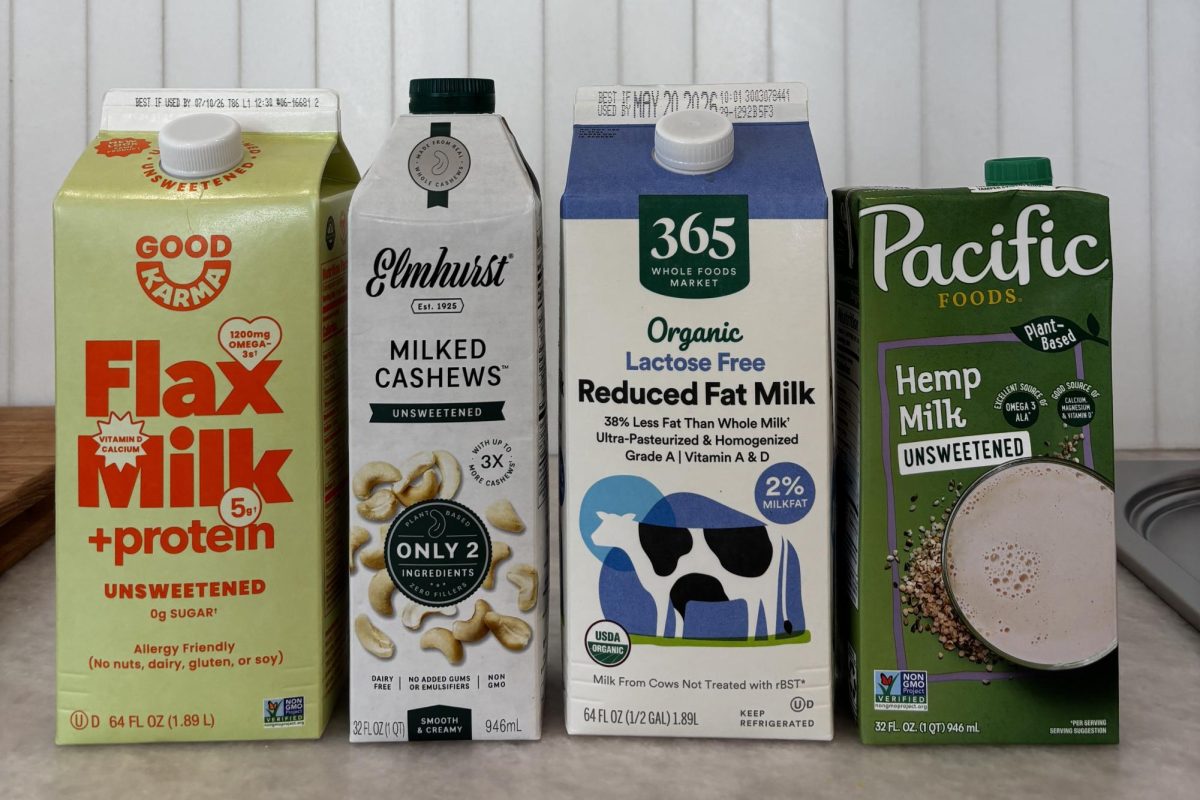
Oatly, Malk, Califia Farms and Silk are some popular plant-based milk companies. Many people drink plant-based milks because of their possible health benefits, taste and lack of dairy.
Many people consume plant-based milk for various reasons, such as dairy allergies, taste preferences or a mission to decrease their carbon footprint. How sustainable are these plant-based options compared to nonplant-based options like cows’ milk?
Dairy milk increases the amount of carbon in our atmosphere the most, making it the least sustainable option. Cow’s milk uses large amounts of land, water and food to raise cattle, releasing the highest amount of greenhouse gases. The process of making cows’ milk is very resource-intensive, making it a less sustainable option compared to some plant-based milk options. The cows are raised on fields, taking up nine times more land than plant-based milks take to grow.
Author, Seth Millstein explains that making one liter of dairy milk requires 8.9 square meters yearly, while oat milk, soy milk, almond milk and rice milk all require less than one square meter for the same result. Additionally, dairy milk requires extreme amounts of water to make. The article states that “it takes 628 liters of water to make just one liter of milk; even almond milk, which is notoriously water-intensive to farm, uses just 59% of the water dairy milk takes to produce.”
An article in the Guardian mentions a key factor to consider when consuming plant-based milk. The article states that “plant milks can, nevertheless, have a dark side, as when any crop is produced in mass quantities.” It is crucial to consider factors such as “how the farming of the crop affects people and native habitats in developing countries,” and whether it is sustainably, ethically and organically grown.
There are many plant-based milk options, each with respective pros and cons. Outlined below are some of the most popular plant-based milk options, and the positive and negative factors of each choice.
1. Almond Milk:
Nut milks in general require much less land to produce, and the trees they are grown on absorb carbon, which is helpful for the planet. However, growing almonds requires large amounts of water, which is an unsustainable practice, especially in areas where water is not plentiful, like California. and , authors of an article in The Conversation reported that “one kernel of California almond requires 12 litres of water.” California and Australia are both drought-prone locations and are the largest producers of almond milk. Additionally, almond cultivation can lead to large-scale bee deaths, weakening the ecosystem. “The biggest environmental concern with almond production in the US is the high mortality of bees, used for tree cross-pollination,” the authors wrote. This is potentially because the bees are exposed to pesticides and the intense industrial agriculture atmosphere, which drastically changes the planet’s fragile ecosystems, and therefore kills the bees.
2. Coconut Milk:
The Guardian describes coconut milk as “an absolute tragedy,” referring to the harsh and inappropriate working conditions that people picking coconuts experience. Additionally, since “coconut trees only grow in tropical climates, the pressure to meet global demand is causing exploitation of workers and destruction of rainforests.” This article explains that a way to combat the mistreatment of coconut farmers is to purchase coconut products that are Fair Trade Certified. When something is Fair Trade Certified it ensures that the farmers and producers are fairly paid and have safe working conditions. Fair trade coconut milk is a sustainable option since it is grown in tropical areas where there is plenty of water, so the climate is not strained to produce this crop.
3. Hemp Milk:
Hemp milk is a newer option on the market, and it has many positive characteristics, making it a very sustainable and nutritious choice. In an article published on the website Forks Over Knives, journalist Lisa Elaine Held describes hemp milk as an “environmental hero” because hemp can easily be grown without pesticides. It also has deep root systems that support soil health, and are resilient to different types of weather; therefore, it can be grown in diverse climates. Additionally, hemp is very good at pulling carbon out of the atmosphere. A drawback of hemp milk is that the seeds are often not locally sourced. This is because of legal issues, as hemp is the same plant species as cannabis, and there are often legal restrictions regarding cannabis production. Although hemp and cannabis are “just two different names for cannabis, a type of flowering plant in the Cannabaceae family,” the key difference between hemp and cannabis is the tetrahydrocannabinol (THC) content. According to Healthline, THC is a chemical found in the cannabis plant. Legally, ‘marijuana’ is cannabis that contains over 0.3% THC by dry weight. Hemp is technically cannabis that contains less than 0.3% THC, so it does not have the same effect that cannabis containing over 0.3% THC has on the body. The article explains that “growing hemp can still be complicated, so many companies have to source seeds from around the world,” which is not very sustainable, as shipping products over long distances uses a lot of resources and produces pollutants like exhaust or smoke.
Although I don’t believe that one plant-based milk can be deemed the overall winner, I do believe that there are many options with immense environmental benefits. Out of the many different types, each has positive and negative effects on our planet’s health. I have tried a few plant-based milks, and I love learning about different companies and types of milk options with various environmental and health benefits as well as sustainable practices.
I hope this column, and my past columns this year, have encouraged others to learn more about the story behind the food they buy and consume. I also hope others have become inspired to live a more conscious life, knowing everything is connected and each choice we make has a greater impact on the health and well-being of our planet and ourselves.