
Editor’s note: The interview with Hector was translated from Spanish by reporter Isabel Kromwyk.
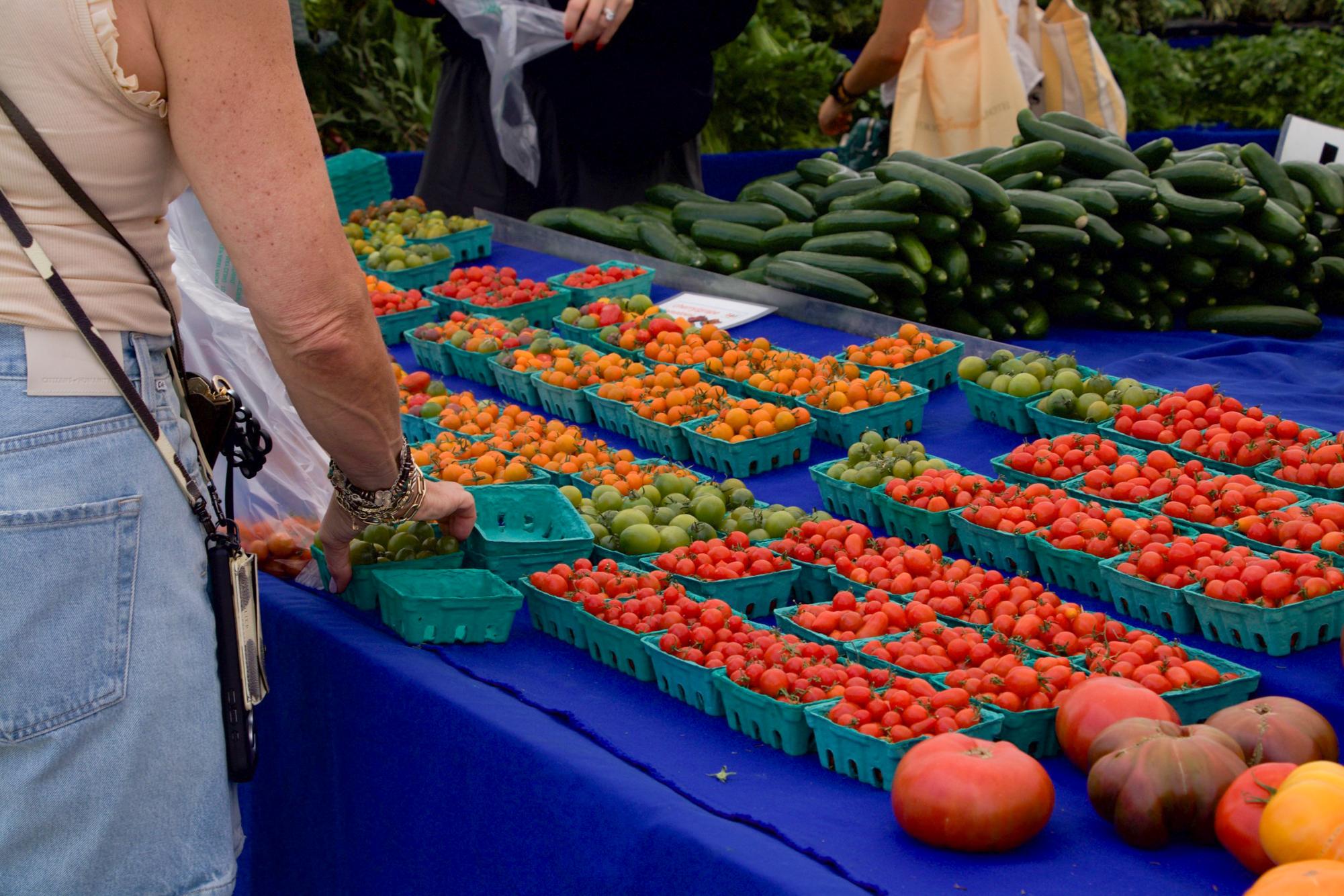
Children run around and play as a customer and vendor make a transaction in the distance, all while neighbors pick out flowers. This is a common scene found every week when residents across Los Angeles come together at their local farmers market to sample foods, support farmers, purchase produce and interact with their community.
Farmers markets are a central part of each community in Los Angeles and attract vendors and buyers from all over the county. Behind the variety of different products and foods available at farmers markets are the countless hours of work put in by vendors to present and sell their products. These weekly markets support local businesses and family-run farms, as well as having a positive impact on the environment.
How a farm works
Around Los Angeles, there are an estimated 766 to 1,035 farms, most of which provide produce for supermarkets and farmers markets.
Hector, who only provided his first name, is the owner and founder of JCK Farms, said he is very passionate about growing plants and selling at farmers markets in Brentwood and Torrance. Hector has worked in the agriculture industry, alongside his family, his whole life. He started out by working on other farms until 2011, but then his friend gave him the chance to grow crops on his lemon tree ranch. Seizing the opportunity, Hector planted his crops in between the existing trees.
“That’s how I started, with a shovel making furrows and planting a little bit of everything because I wanted to have variation, but I didn’t have a lot of space nor many tools or anything like that,” Hector said. “Later on, I increased the quantity of each variety by working hard and using the money that was spared to buy more tools and seeds.”
Today, JCK farms grows a range of local produce, everything from herbs to tomatoes. Hector’s experience comes from watching generations of his family members working with crops. He begins the process of growing his plants and vegetables by going on websites that sell seeds and finding the plants he wants to grow.
“Then we germinate them and keep them there in a hoop house we have specifically for that purpose, to maintain heat and all that for about two months,” Hector said. “Then we transplant them, and there we tend to them until they yield the fruit that we take to the market.”
Arnett Farms, co-owned by Secil Atalay, produces fruits, nuts and homemade jams. Ataly said that growing vegetables is a different process to growing and cultivating fruit.
“We have our pruning season, then we have to have our dormant season where the trees have to get so many hours of sleep, literal sleep, and then when spring comes, they will start to rebloom again. And there’s the pollination process,” Atalay said. “After the pollination, we have the fruit season.”
Arnett Farms uses technology to further the production of their fruit, such as tractors and wind machines to keep the trees from freezing, and laser pointers to scare the birds away. Atalay said that the trees must be pruned in order to produce the best fruit possible. The fruit itself is harvested manually on the farms by workers and the head farmer.
“You prune, you let more sunshine come through the trees,” Atalay said. “You thin the fruit, which means when the fruit starts to set, you separate them a little bit so there’s room for that one particular fruit to grow, so the tree doesn’t try to give nutrients to 800 pounds of fruit because you’ll end up with fruit that won’t be as sweet or as big.”
On the days that vendors are selling at the farmers markets, they transport the produce early in the morning and spend up to 16 hours at the markets. If there are any leftovers, food vendors save them or donate them to organizations like Food Forward.
“At 3:30, I leave my house to get to the market — the farmers market — by 4:40 or 4:45. We set everything up, trying to create an eye-catching display. We always try to make sure it grabs the attention of the people visiting us there,” Hector said. “We get there very early because we want to make the most of every opportunity, from the very first customer to the last. We stay there until 3:00 in the afternoon.”
Catering to small business
According to the Farmers Market Coalition, for every $1 million in revenue, direct-market farms create almost 32 local jobs whereas larger wholesale growers create only 10.5, showing the impact farmers market employment has on small businesses.
Although vendors at farmers markets have to wake up very early, Atalay said Arnett Farms prefers these markets to vending at supermarkets.
“You sell your product and you get paid immediately. At the stores, they sell and then you have to wait for their money,” Atalay said. “The best part of it is serving the consumer directly. A lot of farmers that sell to grocery stores, they don’t know where their produce is going to. It’s really rewarding that I see you buy the apples and I see you week after week.”
Pasean Willson-Ashley is the co-owner of Mama Aunties Vegan Goodies, where they sell a variety of vegan desserts and breads. Willson-Ashley and her business partner sell out of the Studio City farmers market. This market, specifically, supports small businesses by only allowing a vendor to sell there until they start distributing out of a retail store, at which point they must leave the market. Since beginning to supply at farmers markets, Willson-Ashley said this helps support smaller vendors by ensuring everyone has a spot to grow their brand recognition and clientele.
“When we got into the Studio City farmers market, we were just in a couple of restaurants. So there was a very limited audience for our product. But here, there are thousands and thousands and thousands of people who have now tried Mama Aunties and can pass on the word about how great we are,” Willson-Ashley said. “Also, when we go to the next level, which is getting into retail stores, these are people that we can count on to actually go into the retail store and buy our product and tell other people to do the same.”
According to Michigan State University, farmers markets are also more sustainable, primarily because they drastically cut transportation emissions by up to 25%. They promote sustainability through using fewer packaging materials, support for small-scale and eco-friendly farming practices and the encouragement of biodiversity.
Farmers market attendee Riley Keston (’29) said she notices a tangible difference in the food from the farmers market compared to food from the supermarket.
“All the fruit tastes so much better from the farmers market,” Keston said. “All the apples, especially. I feel like you can really taste the difference.”
Building relationships at the farmers market
Apart from the agricultural and economic importance of a neighborhood farmers market, local citizens also participate in them to find community. Both Willson-Ashley and her business partner live near the Studio City farmers market, and she said appreciates how her local community supports her business each week.
“I love it here. We feel like we are supported by people in the neighborhood who want to support small businesses,” Willson-Ashley said. “We have our regulars; we have been here for over four years, so we have people who have been here since day one.”
Slow Stir Foods sells diverse jams and nut butters and is another vendor at the Studio City farmers market. Gloria Baghdassarian has been working for this company for six months and helps sell the jams and butters each Sunday while the owner produces the product. Baghdassarian said, in addition to the relationships formed with customers, the vendor community is a very special part of a farmers market.
“I have a community built with the customers for sure,” Baghdassarian said. “I see the love that they have for products and for the small businesses here, and I really appreciate that because I run an art fair, so this is deep in my bones.”
Atalay said, with such a consistent market, like the one they vend at in Brentwood, she recognizes almost everyone and has seen families and children grow to each stage of life.
“It’s such a full circle — it’s amazing to see that,” Atalay said. “I see these people flourishing and living these beautiful lives, and it’s really nice to witness that … I really love the farmers market.”