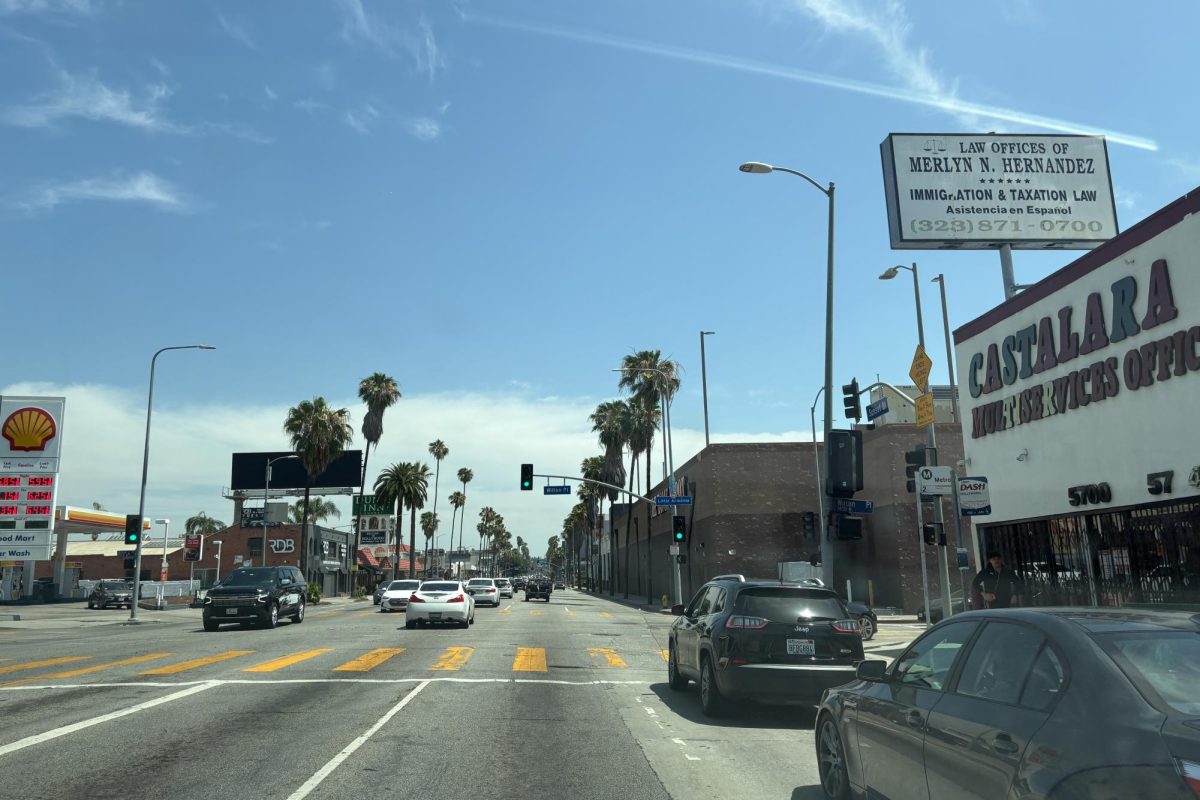
The 405 during rush hour is no longer a road — it is now most akin to a parking lot, where thousands of commuters sit suspended in traffic for more than an hour.
In a city long defined by freeways and gridlock, rising gas prices and growing concerns about sustainability are pushing more Angelenos to reconsider public transportation. These issues are increasing conversations about how public transit could play a larger role in Los Angeles’ future.
Archer 806 bus route driver Eugene Elias said navigating Los Angeles traffic requires patience and constant attention.
“Usually, as a bus driver, I have to be very patient with traffic because I know some other people are maybe desperate,” Elias said. “They may try to cut in front of me. So I have to be very careful and watch out for all those drivers who are desperate because I have a very precious cargo, and that’s the most important.”
Junior Milan Earl is the communications officer for the L.A. Metro Youth Council. Earl said her goal is to encourage more young people to use public transportation to ameliorate transit issues in L.A., while challenging popular perceptions about public transit.
“The council is something to get more youth involved in transportation,” Earl said. “There’s a stigma around public transportation — especially in L.A. — that it’s unsafe. It’s our place to put our input and also to combat that stigma.”
As of Friday, May 8, the first section of the L.A. Metro D Line opened, adding three new underground stations along Wilshire Boulevard. The extension connects Koreatown to the Miracle Mile and Beverly Hills, reducing travel time from Union Station to La Cienega Boulevard to about 21 minutes.
Senior Serenity Jones is currently taking a science class for seniors called Sustainability. She said throughout their urban planning unit, she learned that public transportation can be a more efficient and environmentally mindful alternative to driving, which she does every day.
Still, Jones acknowledged that safety concerns continue to discourage some people, including herself, from using buses and trains regularly.
“I’ve taken public transportation. I think that there needs to be more protocols sometimes for safety, because I feel like that is a thing that people are usually scared of,” Jones said. “I’m not saying that’s super valid, but there are some times where it makes sense.”
Along with combating stigmas, Earl said the L.A. Metro Youth Council is also advocating for expanded student access to Metro through the GoPass program, which allows students to ride transit for free.
“We’re working on implementing GoPasses for students in different districts, even private school students, maybe Archer, to get a GoPass where students can ride the Metro for free,” Earl said. “You don’t have to do it just for school, but students should be able to ride the Metro for free because we are students and we’re trying to do school work and everything like that.”
Elias pointed to distracted driving as another contributor to unsafe roads and traffic slowdowns.
“We have modern cars with a lot of features,” Elias said. “Some people don’t use the features, so they are distracted with the phones. Maybe they just need to sync their phones in their cars. Instead of being distracted, they could pay attention to the traffic.”
Along with distracted driving, rising gas prices are a major point of concern for drivers. The war with Iran has caused a severe surge in United States gas prices, following the disruptions in the Strait of Hormuz. The block of Iranian ports has resulted in one of the largest oil supply disruptions in history. The average cost of gas per gallon in L.A. in May is $6.23 per gallon, as compared to $5.99 in February. This contributes to an overall trend of gas prices increasing over the last few years, largely due to geopolitical conflicts and refinery issues.
Jones said the high gas prices are incentivizing her to use public transportation or walk more often.
“I haven’t even tried to get gas in Studio City. I’m too scared to look at the prices,” Jones said. “I feel like L.A. can be a walkable city if you just know where to go. Like Santa Monica, I think is walkable. Westwood, as well. I think parts of the Valley are super walkable.”
Earl said she recognizes the tension between inaccessible transportation and the lack of walkability in L.A. Though improvements are being made, they’re not being properly publicized to the public, she said.
“L.A. can definitely be improved … L.A. is such a big city, and unlike New York and other cities where it’s more walkable, people need to take transportation, especially with gas prices,” Earl said. “But in L.A., I think what people sometimes struggle with are the safety issues. Many of the trains are being kept up, but it’s not being shown or not being advertised.”
Earl said improving public trust in Metro systems is essential, especially as Los Angeles prepares to host major international events like the 2026 World Cup and the 2028 Olympics. She discussed how New York City Mayor Zohran Mamdani openly uses public transportation and suggested politicians in L.A. do the same.
“Political leaders should advocate for public transportation,” Earl said. “I think it would be very impactful to see our political figures on the bus, riding public transportation with other people. Because that’s what we need to see — transportation is safe for everybody.”