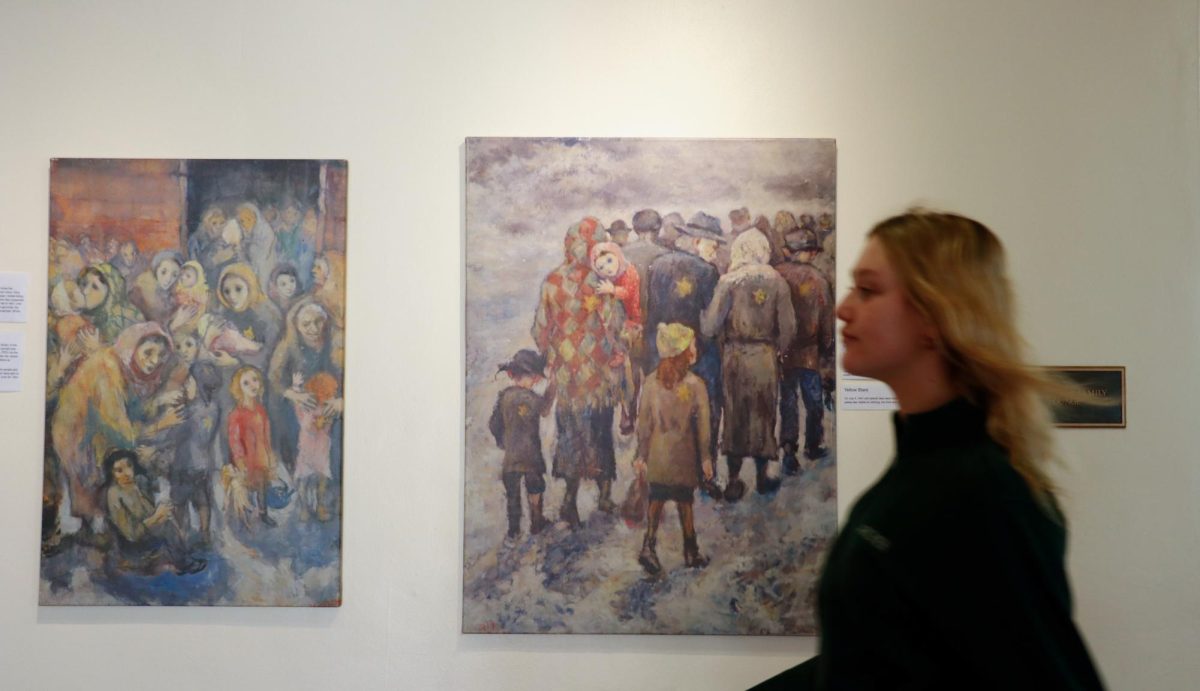
As students pass through the Zimmer Gallery on their way to class, they walk by art created by Holocaust survivor David Labkovski. Labkovski was born in 1906 in what is now Belarus. His family moved in 1908 to Vienna, where he created art based on the Holocaust from different times: before, during and after the genocide. He passed away 34 years ago in 1991. The David Labkovski Project is a nonprofit organization based out of Los Angeles, which uses his artwork to create a bridge between the Holocaust and the current world.
The David Labkovski Project partners with high school students to spread the project’s message by displaying his artwork at schools. Layla Negrin (‘26) got involved with this program when she was in 10th grade through an email from the Artemis Center. She signed up for their leadership program to get involved with Holocaust remembrance and education.
The exhibit opened on International Holocaust Remembrance Day, Tuesday, Jan. 27. Negrin organized the gallery and said it communicates the horrors of the Holocaust and the perseverance of people who experienced it.
“I felt that it was a unique way of showing the Holocaust, but not only the Holocaust — Jewish joy and resilience after,” Negrin said. “I thought it was really timely and present to do it on Jan. 27, and in a way where students have a different way of approaching the subject.”
Negrin said that while it was hard to pick only a couple of Labkovski’s paintings, she knew it was because the message had to be succinct. It was difficult to narrow the selection because each painting tells a unique story, she said, and it was important to make sure the story was easy to follow.
“I thought about the story that I wanted people to see when they were walking through the gallery, so I picked one painting from the start of his life, and then I transitioned to two paintings that I thought were the most important — a before and after,” Negrin said. “The paintings show this comparison of their life, what it was like around their house — it’s, like, this contrast.”
Negrin led the project, and Jewish Student Union adviser Alex Greenberg helped with the setup. Greenberg said she hopes students will feel encouraged to express their understanding of the experiences the paintings describe and explore their own creative side.
“I would hope that they would feel empathy for what survivors went through, and maybe it would encourage them to express themselves through art, as well, especially here,” Greenberg said. “I mean, there are so many opportunities for that. It’s just cool to take a few minutes and walk through, read about each painting and remember that there are so many different ways to express yourself.”
Other ways the Archer community has honored International Holocaust Remembrance Day have been bringing in survivors as guest speakers, such as Gabrielle Karin and Eva Brettler. Greenberg said she prioritizes the experience of guest speakers while also recognizing the power of visual storytelling, noting that this was Archer’s first Holocaust gallery by a survivor.
“It’s amazing that we can have speakers come, but some people are more visual learners,” Greenberg said. “We had never done something like this before, so we thought it would be a cool opportunity for everyone to learn about the Holocaust in a new way.”