
While the gender gap in many fields has decreased, according to STEM Women, women only make up roughly 26%-35% of the global STEM workforce.
Since its conception in 2010, the Archer STEM symposium has aimed to celebrate and recognize female scientists. The symposium has progressed from originally being just Archer students to now hosting girls from schools across Los Angeles, such as Brentwood School, Geffen Academy, Harvard-Westlake School and Flintridge Sacred Heart Academy. This year, the STEM symposium took place Thursday, May 14 and featured presenters, poster sessions, a Q&A panel, food and a raffle competition.
Science Department Chair Hanna Robertson coordinated the event. Her job consisted of figuring out logistics, working with other schools interested in participating, figuring out the appropriate program for showcasing the work and selecting student presenters. She said that a lot of time has been spent planning the event, but she hoped that everyone enjoyed the day as what it was meant to be: a celebration of science and the “incredible” students’ hard work.
“We want to provide an opportunity to showcase and celebrate the work of young women in STEM across Los Angeles by having everybody be able to see and hear about the work that’s being done,” Robertson said. “To enhance, or to meet the goal of greater visibility of the incredible work that’s happening, and not just here on campus — but for our students to be able to learn from other students at other schools about the possible projects and to get ideas about what they could potentially do in the future.”
From Geffen Academy, Session A presenter Seungah Chung (’29) shared her project on the role of the gut microbiome in health and memory of harvester ants. This year, she studied whether giving penicillin and removing ants’ gut microbiome would affect their short or long-term memory. She has been researching ants and participating in the science fair for three years now, she said.
“I’ve done science fair for three years and I’ve always seen the projects of Archer girls,” Chung said. “I really like it here so far and seeing all these different projects. And I think they’re very inspiring, and I might take some of the ideas and apply it for my next research project.”
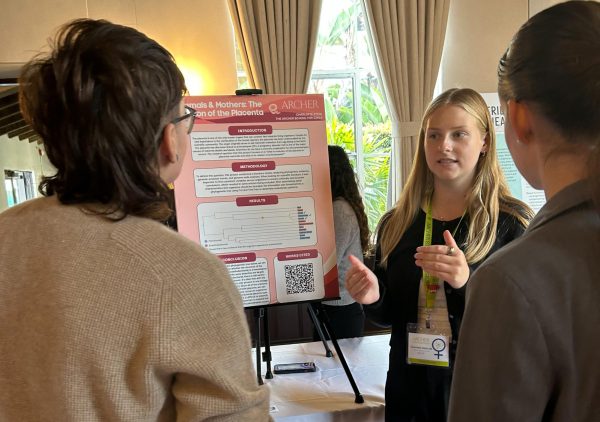
Now in her third year at the symposium, Katia Thomas (’27) presented two projects. One was called the “Critter Crossing Guard” and aimed to protect squirrels. The second project is called “Filtering the Future,” which was a bioreactor system for water filtration, energy generation and environmental protection. She said she enjoyed presenting at the STEM symposium.
“I love having an opportunity to present my research to other people and get other people involved,” Thomas said. “I wholeheartedly think it’s such an important mission because, especially in a world where we see STEM funding cutbacks, specifically for women’s research, it’s really important that we uplift women and girls in the STEM research field.”
Another presenter, Milena Weinberg (’28) from Brentwood School, also stressed the importance of women in STEM. Her project was centered around methane emissions in rice and climate change.
“I think that having a presentation for women in STEM is so, so important. I have a lot of role models and women that I look up to in STEM that really inspire me,” Weinberg said. “I really love the mission of the symposium because it just gives us a platform to present, and I get to have more experience presenting my research because of the symposium, and I like that a lot.”
Roberts said lot of hard work went into the symposium. She defines STEM as a process and said she hopes girls feel empowerd to pursue that process.
“I like to think of it more as like a process than like a product,” Robertson said. “Really just engaging in the STEM symposium, learning about the process that the students have gone through and not thinking about it as — I think science is often thought of as an end product and a body of knowledge, but it is really just a process to learn more.”