



Editor’s Note: This article covers sensitive topics such as eating disorders, which may not be suitable for all readers. If you or a loved one is in need of help, reach out to the National Association of Anorexia Nervosa and Associated Disorders, the eating disorder hotline, by calling (888) 375-7767 or call 988 for the National Suicide Prevention Hotline. All calls are confidential.
Every 53 minutes one person dies from eating disorders in the United States, according to the National Association of Anorexia Nervosa and Associated Disorders. Eating disorders are not selective; people of all backgrounds can be affected, but they’re especially common in women.
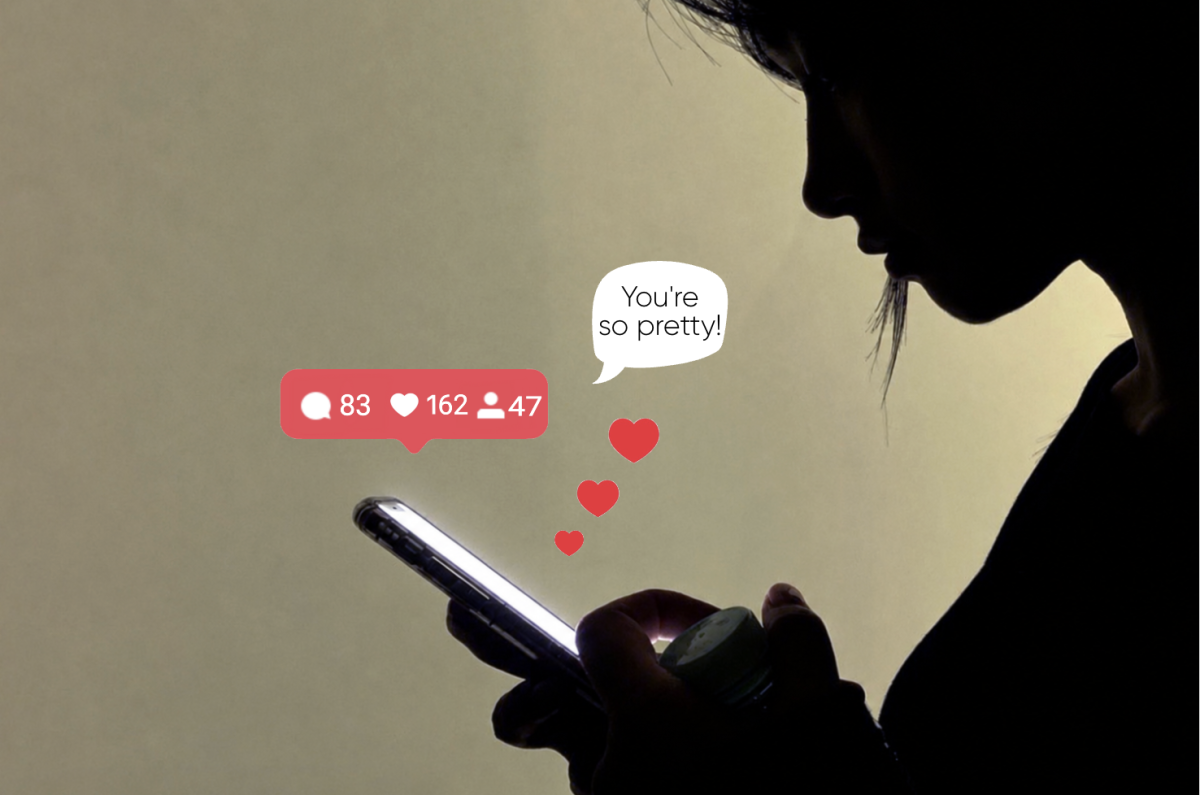
Social media was designed to foster connection, but it is increasingly becoming a space where harmful influences take root. Over the years, a surge of beauty standards and appearance-driven trends has gained traction, often at the expense of teenagers’ well-being.
Licensed professional counselor Stephanie Bartlett specializes in treating eating disorders and conflicts within marriage and family. She said social media can create a more accepting place for people of all body types, where health is the main priority. Still, thinness is the standard on social media, which creates the false idea that everybody needs to be skinny.
“It sets us up to have an even higher … epidemic of eating disorders. It also teaches body shame and rejection,” Bartlett said. “So instead of embracing individuality and looking at the body as the miracle that it is, we’re really more so quantifying it and judging it.”
Anorexia nervosa and binge eating disorder are two of the most common eating disorders, and could impact one’s physical appearance. However, according to Northwestern Medicine, eating disorders are not always related to physical appearance — they vary from person to person, and don’t have a pinpoint cause. Other disorders completely unrelated to physical appearance sometimes get overlooked when people only see them as cosmetic.
Junior Edie Wyles expressed a similar sentiment that influencers on social media can be helpful since they are able to make a safe space for people to express themselves. Nonetheless, it is inevitably harming the younger generations by spreading the idea that everyone needs to look a certain way to be considered attractive, Wyles said.
“It’s just kind of dehumanizing everybody in a sense of ‘everybody needs to look the same,'” Wyles said. “It’s a really toxic thing that’s going to shape the younger generation.”
Leila Boytler is a licensed professional counselor with expertise in helping adolescents and adults recover from eating disorders. According to a study done by the Eating Recovery Center, 46% of teenagers say social media has caused their body image to worsen. Boytler said certain comments on someone’s body can often be extremely triggering if they are struggling with their body image.
“It’s a really tough battle for people internally,” Boytler said. “I can’t tell you just how refreshing it is for people fresh out of recovery to be around other people that don’t talk about food and bodies.”
The Oracle sent out an anonymous survey to Archer’s 269 upper school students, and 57 responded. A strong majority, 82.5%, believe diet culture on social media is harmful. There have been several memes recently that poke fun at people’s bodies, which the respondents agreed were damaging.
In short answer responses, many students said social media can provide some help and healing to those struggling with food; however, the bad effects on those consuming social media can outweigh the good.
“I feel so much more self-conscious about eating food because of how much the terms ‘big back’ and ‘fat’ have been thrown around as hateful language,” one anonymous respondent wrote. “It might be a joke to you, but I guarantee that, for many, this is so hurtful and is not helping anyone.”
When dieting programs are created with little to no science behind them and are released and go viral on social media, they can lead people to develop an eating disorder, Boytler said. Although she said there can be positive messages shared through social media, when people go on strict diets, they often cause more health issues.
“I think the impact I’m … seeing is really strong,” Boytler said. “Stronger than ever — honestly, stronger than when I first started.”
The more these comments become normalized, the more exposed teenagers will be to the idea that their body isn’t what is considered right or the standard, according to an article published in the South African Journal of Psychiatry. Boytler said we need to think more about what we say related to other people and their bodies, including on social media.
“What about the person in a larger body? … How does that feel for them when you say that,” Boytler said. “I think just really remembering it is a form of discrimination, and we need to try as a culture and a society to abstain from engaging in that.”
In this audio clip, Boytler shares a phrase she heard once: “Skinny is not an identity.” She expanded on the idea of skinny being marketed as an identity, when in reality, it is far from it.
There was an increase in disordered eating after the COVID-19 pandemic, which Bartlett attributed to the loneliness and isolation the pandemic created. However, the effects on those with pre-existing eating disorders varied.
“For my clients with anorexia, a lot of them actually did better during COVID because there was less social interaction, less pressure and they were home,” Bartlett said. “For my clients that were more extroverted, there was a worsening … There was more isolation and loneliness, and it was very difficult for them to stay alone.”
Wyles had similar concerns, saying COVID-19 provided younger generations with an excessive amount of time to consume social media that normalized disordered eating.
“It was a huge impact that a lot of people had because they were kind of just you’re stuck with yourself for so long, and you’re always kind of thinking about yourself, and you’re not with other people,” Wyles said. “You don’t have a lot of influence on how to keep your body up to its normal nutrition.”
Instead of teaching young adults that they need to eat a certain amount or diet a certain way, Bartlett said it is best to teach them that everything is okay in moderation.

“If we teach our kids to listen to their bodies, listen to their hunger and fullness cues and to incorporate a wide variety of different foods, then I think they’re going to naturally eat more balanced,” Bartlett said. “They’re not going to be focused on sugar as ‘a reward for eating my food’ or ‘carbs are bad’ or whatever the messages may be.”
According to the University of Utah Health, body shaming comes in many forms, such as saying, “I can’t believe how different you look,” or, “Your nose is so big.” Bartlett said these phrases normalize hating the body, especially the phrase, “I feel fat.”
“One of the things that I will tell my clients,” Bartlett said, “fat is not a feeling.”
Bartlett said that she once heard an acronym for fat, “feeling in area of tension,” from a dietitian she knew. Bartlett also shared an exercise she has her clients do, where they label the parts of their body that they feel strong feelings about.
“If somebody is saying ‘I feel fat, more than likely they are full of feelings,'” she said, “usually the places that they hold most of the negative feelings or challenging feelings that they’re carrying are the areas that they tend to fixate on.”
Since eating disorders are a sensitive topic, it can be difficult to reach out for help or gain the resources needed. Even though it is the source of a lot of harm, Wyles said social media can provide people with the resources they need to help recover and gain a better body image after experiencing an eating disorder.
“There are some creators that are definitely comforting and good people to go to if you’re like struggling with it and you don’t know who to ask,” Wyles said. “And you can see people on social media that highlight it as, ‘these are numbers to call, these are things to do if you’re getting over an eating disorder.'”
Boytler said it’s better to listen than to assume since it’s hard to know exactly what somebody is thinking about themselves. Eating disorders have never been easy to deal with, and it is obvious social media has worsened them, Boytler said. However, if the newer generation is more aware of the effects it can have, there is a possibility of combating their rise in the future.
“You never know what someone’s going through,” Boytler said. “You really never know what kind of relationship with food and their body that they have.”





Clara Lieberstein • May 7, 2026 at 3:18 pm
Thank you so much for writing this article, Sacha!! You’ve addressed such a difficult topic with incredible research and nuance! I hope everyone reads this!