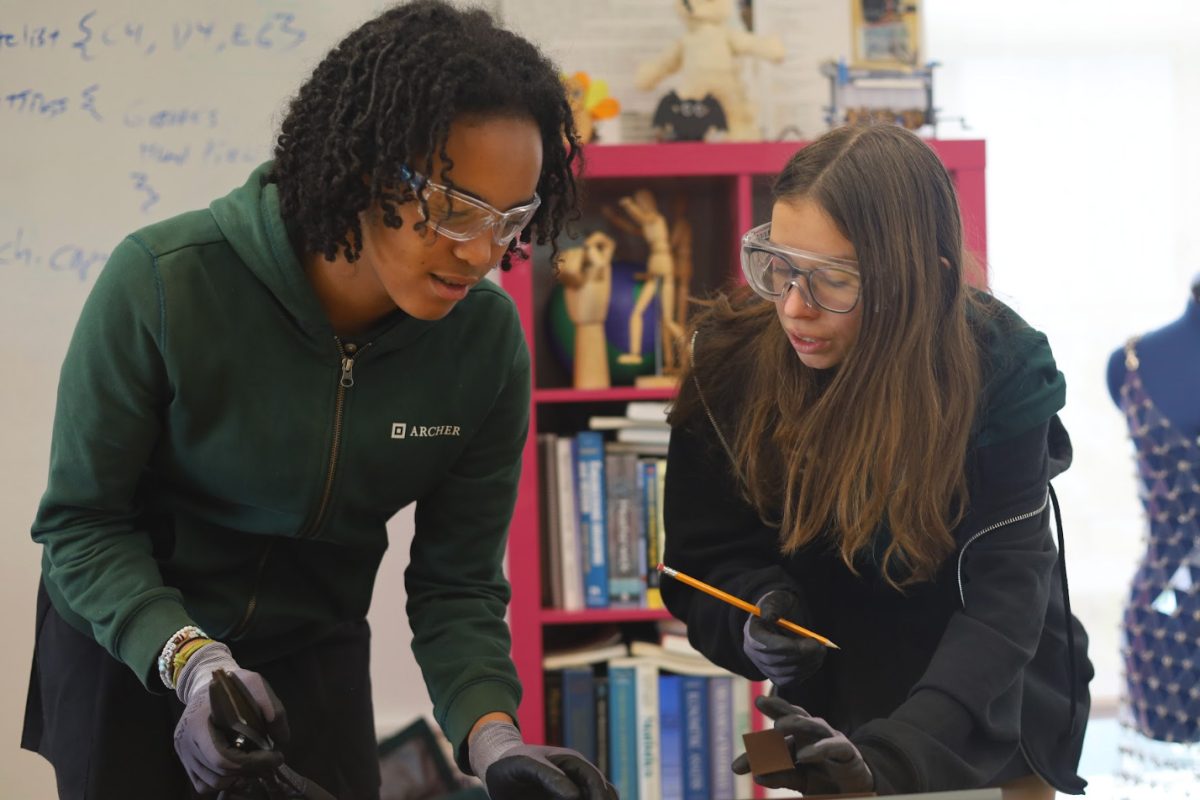
In Archer’s InventionTeam, what may start as a “crazy” idea can turn into a real-world invention, senior Belén Haro said. Haro joined the InventionTeam in ninth grade and is one of the co-administrative leads, alongside Alexa Kagiwada (’26) and Katia Thomas (’27). The InventionTeam, formerly known as the InvenTeam, meets during the FLX block on Days 3 and 8, gathers on Tuesday lunches and is open to all upper school students.
Creativity is an important aspect of the InventionTeam. It shows up when students collaborate on whiteboards covered in sketches that inspire new thinking such as a backpack that can turn from clear to black to help protect against stealing. In order to imagine these new ideas, students begin by laying out pieces of paper where everyone can contribute in writing ideas and pull features from existing patents.
“Creativity is a huge part of [the InventionTeam]. We learned a lot about this importance of ideas and that you never know if an idea is super bad or super good,” Haro said. “[Last year] we did an invention raffle, where students would write something down—for example, ‘I want a dragon that flies and makes me waffles.’ As crazy as that sounds, we could even use that and say, ‘There’s a need for an automatic waffle maker, and how can we make that even accessible to people with disabilities or mobility issues?’ Something like that can expand into something greater … No idea is a bad idea.”
By bringing unique perspectives and skills to the projects, team members contribute in unexpected ways. Haro joined as a photographer her freshman year and did not initially see how that skill related to engineering. However, by studying the project through her camera, she gained a better understanding of key parts and how they worked together, which allowed her to help design and write a patent.
“You are able to apply almost any skill you know, or didn’t realize could connect to engineering,” Haro said. “It isn’t just about technical details or calculations, it’s also about creative problem-solving and using the skills you bring to tackle challenges.”
Kagiwada sees collaboration and different perspectives as a key part of the InventionTeam’s success. She said team members can approach problems through technical research or creative ideas. In projects like FREDD, some team members focused on fire-retardant solutions, while others researched patents and together the team combined their work to create a prototype.
“I might take a more technical approach, and Belén might offer a more general, social approach,” Kagiwada said. “I think it’s the varying perspectives and identities that really make it so that each problem can be solved uniquely and to the best of our ability.”
This year, some InventionTeam students showcased their prototype FREDD at MIT’s Lemelson-MIT EurekaFest from June 9–11, where teams from across the country present inventions addressing real-world problems.
“I think there’s truly something almost magical about seeing a product go from just a concept to an idea,” Kagiwada said. “I go from knowing absolutely nothing to knowing so much about fire retardant. I remember we assembled the entire prototype on the second day when we were at MIT. It was so amazing to see [FREDD] actually in front of us, and think about the tangible impact it could have.”
Mike Carter is the Director of Engineering & Design Programs at Archer and has been a mentor for the InventionTeam since 2015. He said that collaborating in a group is important because individuals can build off each other’s ideas or combine them in new ways. Coming up with multiple ideas also encourages creativity and risk taking.
“Quality is a probabilistic function of quantity; there’s actually research that shows that people who have the best ideas tend to have the most ideas,” Carter said. “One of the great strengths is that there are so many people who have different areas of personal experience whether different relationships, people in their lives with different problems, things that they may have seen as a volunteer opportunity, things they might see on the news. And when you get that breadth of possibilities, then you can come up with really great ideas.”
One aspect of the InventionTeam’s mission, Haro said is to advocate for female leadership in STEM because it is an underrepresented demographic. She wants to encourage individuals who don’t have a STEM background to get more involved.
“The official mission that we have from the Lemelson MIT program is really to inspire the next generation of inventors by having students find the real-world problem and invent a solution to it,” Carter said. “In terms of Archer’s mission, it’s really a way for students to find their passions and apply them to the real world in a way that can have impact. It’s about allowing students to recognize that they have the ability to learn just about anything they need to be able to contribute meaningfully to making global or local problems better.”
Claire Desrosiers (’28) is the communication sub-leader and said that creativity isn’t just about having ideas; it’s about looking at problems from new angles and finding practical ways to make them work in the real world.
“I hope they take away that even the small thing that we do in class together or at a school can make a big change in the world,” Desrosiers said. “Think of a problem, identify how you can do it and solve it because you are capable.”