

![Cinematographer Hoyte Van Hoytema stands, controlling a camera. Hoytema said growing up in Holland, there was less of a forum for those who wanted to go into the film industry, and it was difficult to begin to pursue a career in cinematography. "In order to do it, I had to broaden my horizon a little bit, and there was a lot to learn," Hoytema said. "It took quite some time, but I am very happy I stuck to it." (Photo Courtesy of Bonnie van Hoytema ['28])](https://archeroracle.org/wp-content/uploads/2026/01/IMG_1279.jpeg)
Hoyte van Hoytema begins his day at work by previewing the scenes that will be shot later in the day with the director. He makes sure the lights and camera are ready to go and finally, uses his tools to visually craft a new reality.
Hoytema is the father of Bonnie van Hoytema, an Archer sophomore. As a cinematographer, Hoytema oversees and directs the photography and visuals for movies. He has worked with directors such as Christopher Nolan, Jordan Peele and Spike Jonze. Hoytema has won 73 awards — including an Oscar for his work on the 2023 film “Oppenheimer” — and is known for his work on “Interstellar,” “Tenet,” “Nope,” “Ad Astra” and “Her.”
“I’m very much interested in films, and films and cinema mean that you basically force people to sit in a dark room for several hours,” Hoytema said. “I always think that the visual experience and level of how you experience a film and/or how you experience reality in film is very much dependent on how things appear and how they look.”
By 15 years old, Hoytema said he knew he wanted to go into the film industry, and as he grew older, he felt stronger about it. Growing up in Holland, Hoytema said there weren’t many opportunities to enter the film industry.
“I did my entrance exam to film school in Holland, and I got turned down, so that was very bitter. Then I waited a whole year, then I did the entrance exam again, and, unlucky me, I got turned down again,” Hoytema said. “But every time I got turned down, I got a little hungrier, and I wanted it a little bit more.”
Eventually he was admitted into a Polish film school and began his career. Hoytema said every director he works with gives him varying amounts of creative freedom regarding the visuals. He emphasized the importance of communicating with the director before shooting.
“As a cinematographer, you take the responsibility over the way things look, the light the camera moves, the framing et cetera,” Hoytema said. “Every director has a very different process, and so some directors, they have a very strong affinity towards the visual side of storytelling, and then you have a lot of directors that are not interested at all.”
David Mandel is a director for shows like “Veep,” “Curb Your Enthusiasm” and “White House Plumbers“ and has worked on “Saturday Night Live” and “Seinfeld.” Mandel said it is important to agree with the cinematographer creatively and give them a substantial amount of freedom.
“As a director, you’re looking for somebody who is creatively simpatico with you, who sees the movie the same way, and yet at the same time, you want them to bring them into it,” Mandel said. “I’m not going to hire a cinematographer and then tell them to shoot it the way I would. That would be terrible.”
After building working relationships with them, Hoytema said he often works with directors he previously worked with since they are more familiar with each other’s skill sets and abilities.
“For me, the biggest part, it’s the connection. Of course, it’s always important that I feel that the director is interested in, somehow, visual storytelling,” Hoytema said. “Make an assessment of how your ideas fit into his or her universe … that’s one of the reasons why it’s so nice to work with directors you have worked with before … You have been already on a little bit of a journey together.”
Both Mandel and Hoytema said frequent communication between the cinematographer and executives is crucial. Mandel said when working on the miniseries “White House Plumbers,” he and cinematographer Steven Meizler storyboarded the movie and discussed how they wanted to shoot each scene. Mandel said it was important that Meizler matched the energy of the series.
“It’s a combination of looking for a language that you guys can both speak and … looking for chemistry,” Mandel said.
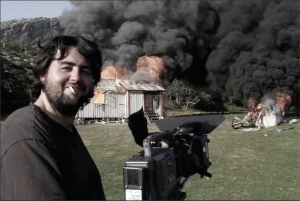
Hoytema said it is important that he carefully crafts the unique worlds of the films he works on.
(Photo Courtesy of Bonnie van Hoytema [’28])
Mandel said the angles can completely change the context of a scene. He said angles are especially important in comedy because they must align with the dialogue and allow room for jokes.
“You could take a scene of two people saying literally anything, like ‘I’m sorry, my mother is dying of cancer’ — a very sad sentence,” Mandel said, “but you could put a weird angle on it and make it seem weird and funny, or you could put it very distant and it would feel very emotionless.”
When working on “Interstellar,” Hoytema said he needed visually capture different space phenomena, such as zero gravity or black holes. He said he studies the world in each film and applies what he has learned to the storytelling.
“It’s a very creative profession,” Hoytema said. “How do you make space? Or how do you make it feel that somebody’s flying with zero gravity through a spaceship? Or what does the sun look like when you don’t have the atmosphere?”
Hoytema said he sometimes invents techniques to shoot scenes, according to his individual style and the scene’s demands.
“It’s not only putting a camera at a certain place, film also requires you to get pretty inventive to even enable or even be able to do certain shots,” Hoytema said. “You’re creating a reality that effectively doesn’t exist.”


Lisa • Jan 30, 2026 at 11:49 am
This is so interesting – the people behind the camera have such important work that so rarely gets recognized. Really enjoyed reading this profile!
Leani Al-Midani • Jan 30, 2026 at 11:22 am
Such an amazing profile great job ellie, this is so interesting! another great article