


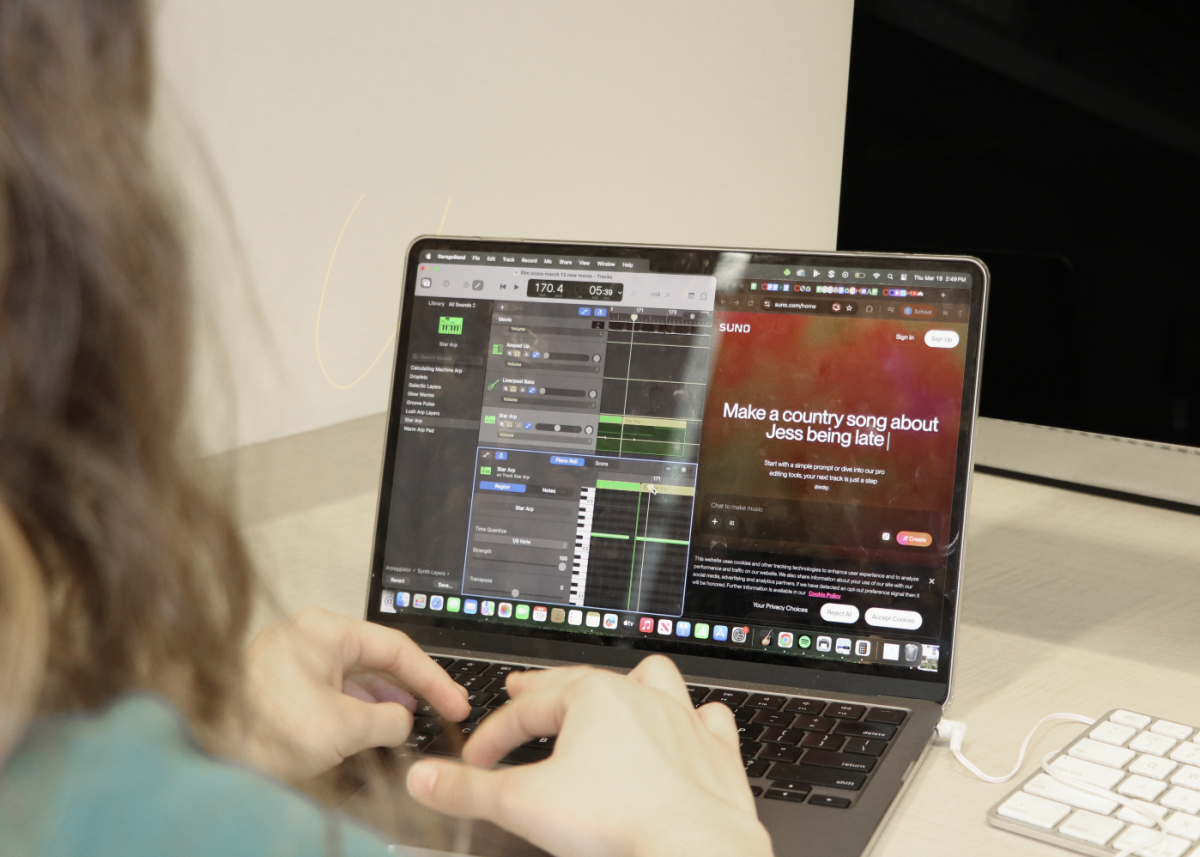
In a classroom filled with keyboards, recording software and handwritten chord charts, composition once started with blank sheets of staff paper. Now, it can all begin with a simple prompt typed into a computer.
Artificial intelligence is rapidly reshaping how music is written, produced and distributed.
Founded in 2007, Deezer is a French-based online music streaming service with 9.7 million subscribers. Deezer offers a catalog of over 120 million tracks, podcasts and radio stations in over 180 countries. Functioning on various devices, it is a mainstream music app for many individuals worldwide. According to a November Deezer-Ipsos report, Deezer has seen daily AI music submissions increase to over 50,000 — about a third of total uploads, a sharp rise from 18% in April.
With submissions skyrocketing on platforms like Deezer, AI music is no longer a niche experiment — it is spreading across mainstream apps, streaming services, social media and interpersonal interactions, reaching listeners worldwide. Music teacher Chris Kapica, who works closely with composition and production, has observed this shift firsthand.
“It has always been floating around in the ether as an idea,” Kapica says. “It’s not just a tool anymore. It’s the end, not just the means to the end.”
Spread Across Major Music Apps and Streaming Platforms
What once might have felt like a futuristic concept — music and words created by machines — is now a daily reality in the world of music streaming and social sharing.
Today, streaming services are being overwhelmed with AI-generated tracks. On Spotify, over 75 million unauthorized tracks — many of them AI-generated — were removed in the past 12 months. This massive volume prompted Spotify to implement new policies to remove AI content.
This flood of content on multiple sources is reshaping how music enters society and how listeners encounter it. Many of these tracks and artists are created with the help of apps like Suno and Udio, where users can type a simple prompt, hum an idea or upload a snippet and instantly receive a complete composition. Rather than relying on traditional musical training or ideas, anyone with an idea and an internet-connected device can push artificial material into the global musical catalog. Kapica described this shift as more than just technological.
“A lot of them are basically either text-based prompt generating. It’s like the ChatGPT of music,” Kapica said. “You can sing an idea into the phone, and it’ll do the rest. These tools are really powerful.”
This shift in accessibility and workflow means that AI tools are not only expanding access to music production and helping seasoned producers prototype ideas, but actively enabling new creators to jump straight to a finished, complete production.
The reach of AI music goes beyond individual creation and into mainstream catalog spaces. AI has entered public listening with cases of AI-generated bands on Spotify drawing real streams.
Apps like TikTok, a massive social media platform where users can create, share and discover short-form video content, further amplify this spread, with AI-generated audios being used in millions of users’ videos. These sounds fuel trends, challenges and viral content, pushing AI music into the daily environments of users around the world. AI sound libraries and prompts are rapidly becoming a part of creators’ tools on these platforms. Junior Charlotte Joe, a student in Kapica’s class, has come across AI artists on mainstream platforms.
“This artist, Xania Monet, she has a million listeners and has a ton of music out, but she’s not real, she’s AI,” Joe said. “It’s gone viral on platforms like TikTok, and people were making dances to her sound.”
Kapica has also seen AI music on different platforms.
“There was that band on Spotify. I think they were called the Velvet Sundown or something. It was a kind of anachronistic rock band,” Kapica said. “It turns out that it’s basically all AI-generated images, music and stuff, and it was generating significant streams.”
Other AI bands and artists like Velvet Sundown can blend into mainstream platforms without obvious labels or studios, reaching listeners through the same broadcast channels that distribute real, human-produced tracks. Popular streaming services like Spotify have become a primary distribution source for AI outputs, where automated content can generate legitimate plays and be disguised alongside traditional artists.
These avenues create an environment where AI music is not only produced at scale, but also distributed, discovered, consumed and perpetuated in the same spaces as human-made music — making the spread truly widespread across the musical ecosystem.
Consumer Awareness and Confusion
AI music is spreading virally across the internet, leaving listeners unsure about whether what they are hearing is human-made or machine-generated. According to a survey from the Deezer-Ipsos report, a staggering 97% of listeners can’t distinguish between AI-generated and human-composed songs. Fitness and wellness teacher Terri Martin encountered an AI-generated track online, during the Kendrick and Drake feud, and didn’t realize it was fully AI-generated.
“I thought the song was really good. I’m like, ‘Wow, Drake released a new song. He’s really rapping,'” Martin said. “It was 100% creative, and the beat was fire.”
She discovered the song on X, formerly known as Twitter. Like many listeners, she was scrolling through social media and came across the video, never realizing the track was AI-generated.
“I was going through the comments and saw someone mention that this was a piece created by AI,” Martin said. “I was talking to my friends, and they were like, ‘Yeah, I saw that too.’ It was fake, and I couldn’t believe it.”
The viral spread of AI tracks highlights the disconnect between perception and reality, according to X. Social media platforms easily allow songs to circulate rapidly, reaching millions without any disclosure. Joe described how even older listeners, like her grandma, are easily misled.
“My own grandma follows AI Barbara Streisand. She’s not aware, and she comments on her posts,” Joe said. “I’m sure she’s listened to an AI song and hasn’t realized, and I think that’s because AI is so new and spreading.”
The rapid spread exposes how little listeners can discern authenticity. Their experience underscores a growing lack of awareness as a result of AI music.
The Risk In Undermining Authentic Voice and Human Experience
According to Yale University, AI’s ability to generate music instantly is reshaping the value of recorded tracks, traditional composing, singing and musical creativity. Kapica worries that recorded music could become a disposable product as AI can now produce background tracks for TV shows, films or playlists with a simple prompt, ultimately bypassing the traditional role of composers and the natural craft behind their work.
“Live music and the human experience, the connection that everybody wants from music, will still be valued because it takes craft to learn how to play the guitar and sing,” Kapica says. “It’s just recorded music that is in trouble.”
For songwriters like Joe, AI also poses as a challenge, overlooking the meaning of effort and authenticity. Joe commented on this concern from her perspective as someone who has invested years into the craft.
“I’ve worked so hard to be at the level I am in music because I’ve taken music classes. I’ve taken 10 years of piano lessons, and I feel AI can just make that in five seconds,” Joe said. “It feels like they are taking our work. They’re making it seem like something that’s not important for the world, but that’s really essential for authentic music.”
Even beyond perception, Martin said AI finds human emotional depth hard to replicate. Martin said human songs carry the imprint of lived and enjoyed experience.
“Artists communicate personal experiences and beliefs. AI can’t replicate that. Musicians put time and energy into songs that resonate for generations,” Martin said. “With AI, we lose some of the beauty and depth of that craft — there’s no depth, it’s just surface-level content.”
As more AI enters mainstream media, it brings speed, efficiency and limitless production, but it remains unable to replicate the artistry, skill, emotional depth and cultural storytelling embedded in human-made music. As Kapica puts it, the challenge is to preserve these human elements and combat the machine.
“We make this stuff not just because a machine can, but because we want to prove to ourselves we can do it,” Kapica says. “We have something to say that exactly machines don’t.”
In the audio clip below, Kapica talks about how using AI as a shortcut in music education can strip away the real learning and fulfillment that come from doing the hard work yourself.






Hollyn Alpert • Apr 18, 2026 at 6:28 pm
Fantastic work, Amelia! Such an important, well-covered story.